VANCOUVER, BRITISH COLUMBIA–(Marketwired – Aug 29, 2014) – Delta Gold Corporation (the “Company” or “Delta“) (TSX VENTURE:DLT) reports that it has filed on SEDAR (www.sedar.com.) its unaudited condensed interim consolidated financial statements and related management discussion and analysis (“MD&A”) for three and nine months ended June 30, 2014.
The Company reported a loss and comprehensive loss for the three and nine months ended June 30, 2014 of $454,079 and $3,775,122 respectively compared with $591,406 and $2,636,738 in the three and nine months ended June 30, 2013.
The activities in the current financial reporting period focused on business development investigations and the recently announced transaction with Commonwealth Silver and Gold Mining Inc. (“CSGM”),
The Company’s working capital at June 30, 2014 was $4,298,678.
On June 6, 2014 Delta and CSGM signed a definitive arrangement agreement (the “Transaction”) with respect to a proposed combination which would result in a reverse takeover of Delta by CSGM.
The Transaction with CSGM is now expected to close by the end of October 2014. Finalizing the required documentation and responding to queries from the TSX Venture Exchange has delayed the overall process and the concurrent financing. The Company expects its stock to remain halted from trading until the closing of the Transaction.
Delta’s CEO, Marco Romero, stated: “We continue to focus on closing the Transaction with CSGM. This will allow us to diversify and to deliver a nearer term gold and silver mine development opportunity with strong exploration potential that is synergistic with the Imperial Project. We have also continued our dialogue with the Quechan Tribe, striving to develop a mutually respectful working relationship that will allow us to move forward collaboratively with the Imperial Project feasibility study and related activities”.
Delta Gold Corporation is a development stage mining company with the goal of building a successful mid-tier gold producer committed to industry-leading technical and ethical best practices. Our business strategy is to identify and evaluate mineral investment opportunities located in favourable jurisdictions and settings, and to prudently acquire and develop projects that are economically, socially and environmentally viable.
Neither the Exchange nor its Regulation Services Provider (as that term is defined in the policies of the Exchange) accepts responsibility for the adequacy or accuracy of this release.
Forward Looking Statements
This document may contain “forward-looking information” within the meaning of Canadian securities legislation and “forward-looking statements” within the meaning of the United States Private Securities Litigation Reform Act of 1995 (collectively, “forward-looking statements”). These forward-looking statements are made as of the date of this document and Company does not intend, and does not assume any obligation, to update these forward-looking statements, except as required under applicable securities legislation. By their very nature forward-looking statements involve known and unknown risks, uncertainties and other factors which may cause the actual results, performance or achievements of Company to be materially different from any future results, performance or achievements expressed or implied by the forward-looking statements.
Contact:
Delta Gold Corporation
Marco Romero
President & CEO
604-681-2020, ext. 101 info@deltagold.com
WE CAN STOP COMMONWEALTH SILVER AND GOLD MINING, INC. FROM LAYING WASTE TO OUR ENVIRONMENT … depleting our water supply, polluting our land with their toxic processing chemicals, destroying our town, our valley, and our beautiful Cochise Stronghold.
THE COMMUNITY RIGHTS MOVEMENT IS ONE OF THE MOST EXCITING MOVEMENTS OF OUR TIME!
150 communities in nine states have managed to pass ordinances that stop corporations from moving in … they’ve been able to stop natural gas fracking, huge factory farms, and other big business. All communities have rights for their citizens.
Who makes the decisions in our community?
The rights-based model of community action is being called the new frontier of the civil rights struggle, because it is our own state and federal laws that are standing in the way of our right to determine what happens to us in the places where we live. The biggest threat posed by corporations is not the illegal stuff of headlines. The real danger is what big corporations are empowered to do legally, every day, in every community across the country. From water withdrawal to polluting refineries, toxic sludge spreading, GMOs and more, the corporate few wield the law against our communities, endangering our health, safety and the environment.
State and federal law says that corporations don’t need community permission to drop pesticides overhead, or to site a toxic dump next to the school grounds. So who does decide? State agencies issue corporations “permits” and state legislatures routinely “preempt” (usurp) community lawmaking authority on behalf of those corporations. When corporate executives decide to site an unwanted project in our communities, we are told we cannot say “no,” because that would be a violation of the corporation’s Constitutional rights. But we can change that. You or I can’t dump or store toxic waste in our back yards, poison our water with deadly chemicals, yet corporations can? What kind of righteous, self-serving laws are these?
The community rights movement is providing a framework to transform grassroots organizing to protect people and the planet.
Rights of nature – We cannot truly protect the environment if the law continues to see nature as mere property to be exploited at will. Slaves were once property, until we changed unjust law to recognize their rights. We’re at the forefront of a commonsense global revolution for nature’s rights.
Corporate Power and Personhood – Corporations are not people, and should not have the same “rights” afforded to people. The community rights movement seeks to strip corporations of the legal powers and protections (including Corporate Personhood) used to override the will of the people in their communities.
Restoring Democracy – It’s time to put the “we the people” back into the democratic process. A strong community rights program will provide a legal framework and organizing model for the public to assert their inalienable rights in the place it matters most — where we live. Organizing for community rights is the current chapter in the struggle for our civil rights. We ask you to join us in fighting for your RIGHTS.
The following information is from 2001 and the issues addressed are still as relevant today as they were then. Issues we should be concerned about regarding Commonwealth Silver’s proposed open pit cyanide gold mine in our community of Pearce, Arizona include the topics of Water, Waste Rock, Cyanide, and Ecosystem Impacts.
Over 85% of gold mined today will end up as jewelry tomorrow. Gold mining is not an essential industry like the harvesting of food or even paper production. It is certainly not sustainable, nor is it just. Yet the cumulative impacts of gold mining worldwide, on local economies and ecosystems, are at least as bad as those of industrial forestry and agribusiness. With more than 66% of all new mining exploration in the hard-rock sector currently focused on gold, the problems are going to get worse for people and places around the planet. Here’s why:
1. GENOCIDE
Every major gold rush has meant death and devastation for local people at the hands of fortune-seekers. California’s Native American nations were decimated first by the diseases the 49ers brought with them, then by the new California state government, which put bounties on the heads of native people. Today the Galamsey of West Africa, the Igorot of the Philippines, and the Macuxi and Yanomami of the Amazon are similarly endangered. The Yanomami, for example, had little contact with the rest of Brazil until the arrival of the first garimpciros (gold miners) in the 1970s. By 1989, an estimated 40,000 miners had flocked to the area, polluting rivers and spreading malaria. Decimated by disease, the number of Yanomamis living in Brazil (many also live in Venezuela) fell from 20,000 to about 8,000 in just 20 years. In the words of Yanomami representative Davi Kopenawa Yanomami, “What we do not want are the mining companies, which destroy the forest, and the garimpciros, who bring so many diseases. These whites must respect our Yanomami land. The garimpciros bring guns, alcohol, prostitution, and destroy nature wherever they go. The machines spill oil into the rivers and kill the life existing in them and the people and animals who depend on them. For us, this is not progress.”
2. WATER
Damage to water and water resources is the worst environmental consequence of gold mining. From California’s Sierra Nevada in the 1850s to the lands of the Pemon in Venezuela today, people have ruined rivers by using high-pressure hoses to spray down the banks and sifting through the sediment for gold. Runoff flows downstream, destroying plant and fish life. But modern mining is even more destructive of water resources: the gold industry in Nevada – where most gold in the United States is mined – consumes more water than all the people in the state. The water table has fallen as much as 1,000 feet around some of the largest open-pit gold mines in northeastern Nevada, according to the U.S. Geological Survey. One of the mines consumes 100 million gallons per day – as much as the city of Austin, Texas. And that’s not all: Water systems around mines are contaminated by cyanide and other processing chemicals, and the acid mine drainage that runs off exposed rock.
3. WASTE ROCK
To make a simple gold wedding band, at least 2.8 tons of earth are excavated. The gold-mining industry generates an enormous amount of waste compared to its product: The 2,402 tons of gold produced in 1997 resulted in 725 million tons of waste, which was contaminated with metals, acids, and solvents, according to Worldwatch lnstitute. The standard ratio of waste production in the U.S. gold-mining industry is one to three million, meaning that for every ton of gold produced there are three million tons of waste rock. Most of the unsightly mess left behind is exposed to weathering and will ultimately leach acid and heavy metals into the local area at great ecological cost.
4. CORPORATE WELFARE
In many countries, gold-mining companies are allowed “free entry” to public lands for mineral exploitation. In the United States, it is not entirely free – but the companies only pay $5 an acre to “patent” a patch of federal land and open it to mining. Since 1872, the government has “sold” land equivalent in size to the state of Connecticut under this law. This land contained $245 billion worth of minerals! Pushed by corporate advisors, developing countries are adopting similar land policies as well. Since 1994, more than 70 countries have changed their laws to attract foreign gold-mining companies. As a result, the gold-mining industry in the global South is booming: Between 1991 and 1997, exploration investments doubled in Africa, quadrupled in the Pacific region, and expanded by six times in Latin America. Since a “pro-development” mining act was adopted in 1995 in the Philippines, over a quarter of the country’s land surface has been handed over as gold mining prospects.
5. INDIGENOUS RIGHTS
In the United States – the world’s second biggest gold producer – more than 70% of gold is ripped from native lands. The Western Shoshone, whose traditional domain covers most of Nevada, are the unhappy hosts to more than three dozen open-pit gold mines on their land, many at least a mile wide and a mile deep, with toxic ponds at the bottom. The U.S. government has continually denied the Western Shoshone their land and treaty rights, as it increasingly allocates Nevada’s lands to multinational mining. The story repeats itself around the globe. In Ghana, in the mid-1990s, thousands of traditional farmers were evicted and replaced by World Bank-sponsored gold mining operations covering hundreds of square kilometers. It is now estimated that 50% of gold produced in the next 20 years will come from indigenous peoples’ lands.
6. CYANIDE
Cyanide is the chemical of choice for mining companies to extract gold from crushed ore. Very low-grade ore, with minimal residues of gold, is crushed and piled on the ground, then sprayed with a cyanide solution. No mine has ever avoided leaking cyanide into the ecosystem. In 1998, a cyanide spill on a Canadian-owned gold mine in Kyrgyzstan resulted in four deaths and the evacuation of thousands of people living downstream. At one southern Colorado mine, Summitville, taxpayers have already paid out $100 million for the Environmental Protection Agency (EPA) to simply contain – not clean up – contamination of local rivers.
7. MERCURY
For centuries, mercury has been used to chemically separate gold from ore, leading to major public-health problems for miners and communities around mining districts. During the California Gold Rush, 7,600 tons of mercury were released into local rivers and lakes, resulting in neurological disorders and deaths amongst people exposed to this deadly toxin. More than 50% of mercury exposure today in the San Francisco Bay area is a historic legacy of the 1849 gold rush. Furthermore, millions of small-scale miners use mercury, from the Amazon – where they have invaded indigenous reservations – to the Philippines, resulting in the worst recent outbreaks of Minamata (or “Mad Hatter’s”) disease. Of 500,000 gold miners tested in Brazil, more than 30% showed mercury levels above the World Health Organization’s tolerable limits.
8. DOWRY
Nearly 80% of gold is sold as jewelry, most of it in India. In 1998, the country’s gold consumption added up to 815 metric tons, nearly twice that of the United States. This is not, however, a simple tale of vanity or excessive consumption. It is part of the dowry women pay for a man’s hand in marriage. Activists working around the gold industry aim both to redress the abuses of mining for communities living in mineral producing areas, and to challenge the patriarchy that forces women to hold gold as their only fallback in times of scarcity. Indian women and activists fighting the dowry system are becoming increasingly aware of the dangers of gold production worldwide. As long as there is pressure on Indian women to own gold, however, it can be derived from non-virgin production. Gold in the vaults of the “developed world” could feed the demand even for India’s market for years to come.
9. DUD INVESTMENT
According to Merrill Lynch, gold is “the duddest of dud investments.” Ever since the U.S. dollar went off the gold standard. gold has had no special value as a commodity, with only 280 tons going to industrial uses per year. Yet some people continue to hoard it. The price of gold has been slowly dropping and is now well below the price of its production at many modern mines, which means companies mining new or “virgin” gold are a bad investment. Even the 35,000 tons of gold bullion held in central banks have lost 30% of their value over the last decade- a huge waste of taxpayer assets. Some governments are already beginning to sell off their gold reserves. In the last five years, the Argentine, Australian, Belgian, British, Canadian, Dutch, and Swiss central banks have sold large quantities of gold, as has the International Monetary Fund, causing the price of gold to plummet.
10. ECOSYSTEM IMPACTS
Contamination and waste of water, destruction of habitat and biodiversity, industrialization of wilderness, road-building, and waste-dumping in mined areas all negatively impact the environment around gold mines. “Frontier forests” – the last remaining old growth stands – are under siege from gold exploration. Fisheries suffer from heavy siltation and toxic run-off into waterways from gold mines. Today, mines scrape away and dig up more earth than do the world’s rivers through natural erosion. The impact on wildlife is hard to calculate, but between 1980 and 1990 seven thousand birds were found dead near cyanide-laced ponds at gold mines in California, Nevada, and Arizona – the tip of the iceberg of gold mine-related wildlife deaths.
Democracy in the Pits is a two-part series outlining the tarnished reputation of Canada’s mining sector and the Harper government’s role in supporting it.
In a recent article chronicling the demise of Canadian social democracy at the hands of the Harper Conservatives, Marianne Lenabat draws an important comparison: what the financial sector is to the United States, so are the extractive industries to Canada. The similarity isn’t just about the two sectors’ relative size or contribution to GDP, although it starts there. It’s about how each country’s respective darling industry has come to dictate government policy, even when the social harm they inflict far outweighs their economic benefits… Read Full Article
Mining Spill Near U.S. Border Closes 88 Schools, Leaves Thousands Of Mexicans Without Water
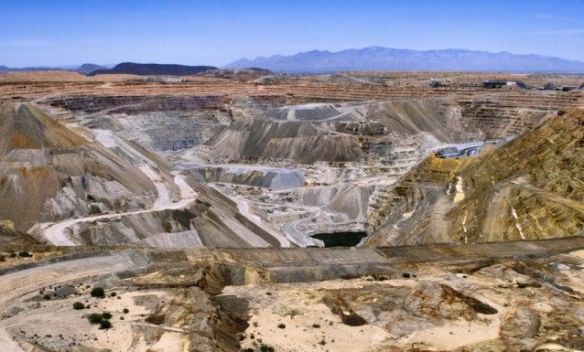
Open pit copper mine near Tucson, Arizona.
An acid spill from a large copper mine in northern Mexico is keeping 88 schools closed starting Monday due to uncertainty over the safety of drinking water. The 12-day-old spill, which sent 10 million gallons (40,000 cubic meters) of toxic wastewater into portions of the Bacanuchi and Sonora rivers, may keep schools closed for over a week according to the Associated Press.
The Buenavista copper mine, one of the largest copper mines in the world, is located in Cananea, Sonora, about 25 miles south of the U.S. border near Nogales, Arizona. The mine is operated by Grupo Mexico, one of the world’s largest copper producers. Grupo Mexico’s American subsidiary, Asarco, is nearing a deal to gain full ownership of the Silver Bell copper mine across the U.S. border in Marana, Arizona and has been subject to major environmental misconduct charges in the past relating to its mining operations… Read Full Article
Critic of the Canadian mining industry, Alain Deneault, talks to Richard Swift about the destructive nature of this sector.
Easy-to-reach sources of ore have already been exploited. How much longer will we continue to destruct our world?
Alain Deneault is a social scientist from Quebec and a leading critic of the Canadian mining industry. His book Canada Noir brought a lawsuit from the Canadian mining giant Barrick Gold. In this interview, he tells the story of Canada’s shocking record of human and environmental abuse in the mining sector… Read Full Article
Mining companies are clearly not protecting the waterways near their mining operations. Mining companies dump more than 180 million tons of hazardous waste each year into rivers, lakes and oceans worldwide, according to a report by Earthworks and MiningWatch Canada. The amount of mine waste dumped a year is 1.5 times as much as all the municipal waste dumped in the U.S. landfills in 2009… Read Full Article
Note key mining companies mentioned in this article include Barrick Gold and GoldCrop, both Canadian mining companies.
The following article was written by Ainslee S. Wittig of the Wilcox Range News, and originally posted to WillcoxRangeNews.com on Wednesday, August 6, 2014 12:00 PM.
All text in black is from the original article in its entirety. Comments below each paragraph in red are those of CommonwealthMine.org.
Commonwealth Mine update following public meeting in Sunsites
Meeting in Sunsites calms some concerns; others still question
Hall Stewart, vice president, exploration and director of Commonwealth Silver and Gold Corp., makes a presentation at the Sunsites Community Center July 22 about the Commonwealth Project in Pearce.
Hall Stewart made a presentation at the Sunsites Community Center July 22 about his company’s plans in the area. The Pearce-Sunsites Chamber of Commerce hosted the meeting. About 150 people attended, many supportive of the proposed mines and many concerned about local water depletion and contamination.
FACT: Of the people who attended this meeting, about 80% stayed afterward to share concerns as a community about the mine. As usual during the “update” Hall Stewart glossed over the issue of water depletion and the fact that it is a major negative consequence of gold mining. His example was center pivot crop circles….crops, by their nature, provide food. What does this waste of water provide? The large amount of water required to run a gold mining operation would exacerbate its impact on our community, which is already experiencing drought. In addition to concerns of water depletion are our concerns of our water being contaminated with toxic chemicals such as cyanide. The video below is a good example of such events happening in real life due to gold mining practices.
The Commonwealth Project is held by Commonwealth Silver and Gold Corp. (CSGC), a private Arizona company, incorporated in 2010. CSGC is 100-percent wholly owned by Commonwealth Silver and Gold Mining Inc. (CSGM), a company incorporated under the federal laws of Canada.
FACT: Every time Hall Stewart talks about the name and legal formation of his company it’s a different story. His words state that CSGC is 100-percent wholly owned by CSGM, a company incorporated under the federal laws of Canada.
Then Hall Stewart said, “In regard to the concern that Commonwealth Silver and Gold Mining, Inc. is a Canadian entity“….”the majority ownership of the company is Canadian it is because there are few John Waynes left in this country that have the cojones to invest the time, effort and money required to make discoveries and develop them to the benefit of the communities where they are found“, (exactly what are the benefits to our community?) which you can verify athttp://www.willcoxrangenews.com/opinion/editorials/article_d1a82aae-e5fa-11e3-a973-001a4bcf887a.html
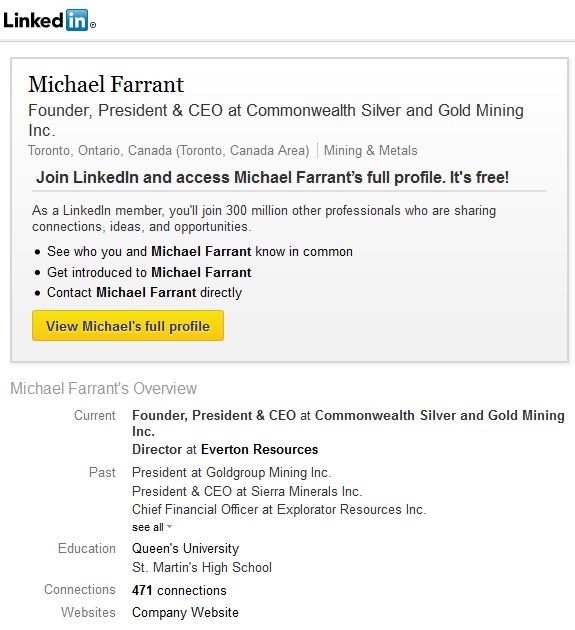
Hall is Vice President, Exploration and a Director of CSGM and President and Director of the US subsidiary CSGC. Hall and CEO and President Micheal Farrant are co-founders of both companies.
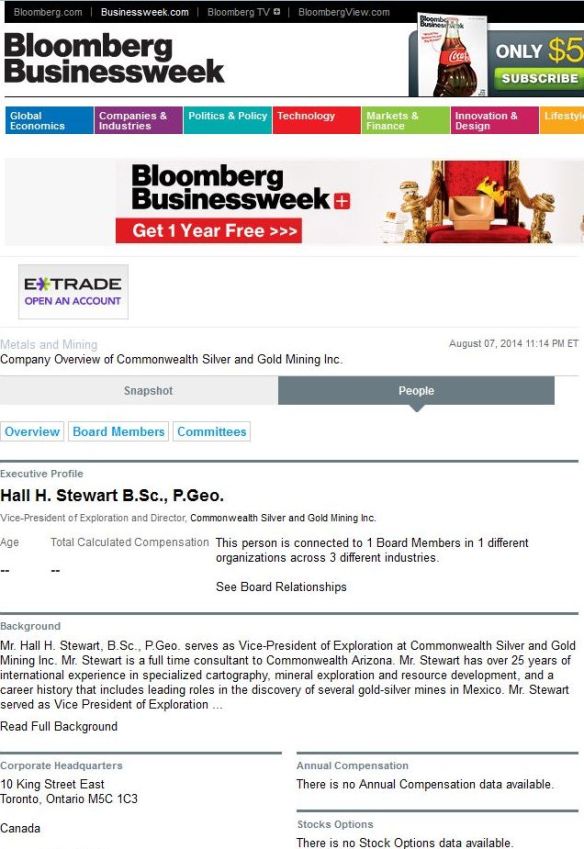
FACT: Publicly available information, such as that shown below, does not show Hall Stewart as a co-founder of Commonwealth Silver. Why is Mr. Stewart so anxious to convince our community that he is a co-founder of this Canadian company? Review the following information provided by Mr. Stewart and Mr. Farrant and make your own judgement.
In addition, Bloomberg Businessweek states that Hall Stewart “serves as Vice-President of Exploration at Commonwealth Silver and Gold Mining Inc. Mr. Stewart is a full time consultant to Commonwealth Arizona“. Note that Commonwealth Silver would have provided this information to Bloomberg Businessweek. (Bloomberg doesn’t make this information up).
Stewart said he decided to make the presentation to dispel inaccurate information making the rounds locally, as well as false statements made by a website, commonwealthmine.org, whose bloggers have failed to identify themselves to Commonwealth Silver and the public.
FACT: The only reason this meeting happened is because we, as a community, have started questioning what is really going on with the Commonwealth Mine Project, which we, as residents of our community, have the right to question – whether or not we identify ourselves is irrelevant.
FACT: If you visit http://commonwealthsilver.ca/ you will find that our town is the only mining project they have, and they are betting our community on making lots of money for themselves and their investors at our expense and risk.
“I’m proud of my work. I put my name on it. Nowhere on their website do they identify themselves and they are making very unsubstantiated claims,” Stewart said toward the end of the meeting.
FACT: You, who are reading this right now, are most likely an adult who can discern information for yourself, regardless of who put it together. You don’t need Hall Stewart to tell you what is true or not. Look at the information on our website and judge for yourself. Everything we present on this site is substantiated by leading sources, such as Bloomberg Businessweek, MIT (Massachusetts Institute of Technology), Global News BC, EARTHWORKS, The Center for Public Integrity, Smithsonian Magazine, CORPWATCH, The Willcox Range News, etc. Whereas everything you hear from Michael Farrant and Hall Stewart is completely based on whatever “unsubstantiated” claims best serve their financial interests at any given moment. Nowhere, do they present credible facts to validate any of their claims.
Stewart told the audience it had been two years since their last meeting and it was time to give an update on the progress the company has made. The company has however provided presentations and updates annually at the Old Pearce Heritage Days in each of November 2011, 2012 and 2013 during Thanksgiving.
FACT: As previously stated in this article, “Stewart said he decided to make the presentation to dispel inaccurate information making the rounds locally, as well as false statements made by a website, commonwealthmine.org, whose bloggers have failed to identify themselves to Commonwealth Silver and the public.” This was the real reason for the meeting, it had nothing to do with his concern for our community.
Farrant attended and spoke minimally during the presentation.
FACT: Being the President and CEO of Commonwealth Silver, you would think that Michael Farrant would have more to say to the people of our community, however, he showed, by his arm-crossed across his chest behavior that he could care less about any of us. He is only in this for his own financial gain (regardless of any negative impacts on our community). Furthermore, Michael Farrant has been hiding from our community from the very beginning, which you can verify in the following articles from the Willcox Range News. He finally showed his face to our community due to pressure from CommonwealthMine.org.
Stewart explained the three projects the company is working on: Commonwealth Project at Pearce Hill, San Ignacio Hill, about a mile east of Commonwealth Mine next Highway 191 and Blue Jeep, northwest of Kansas Settlement Road and Highway 191.
The Commonwealth Project is an advanced exploration development project located at Pearce Hill, where the deposits were mined for high grade silver and gold ores beginning in 1895 (known as Commonwealth Mine), with commercial scale mining of the high grade ores ending in the late 1920’s. Small scale mining continued through 1942. During this time, the Commonwealth Mine produced about 12 million ounces of silver and 138,000 ounces of gold, making it Arizona’s second largest historic primary silver producer. Further exploration and drilling continued from the 1970s through mid 1990s until a sharp decrease in silver and gold prices.
FACT: If any of you know about what happened with the Commonwealth Mine in the 1990s, you would think twice about supporting this venture. As for what happened, you can find out for yourself by asking some of our old-timers. Not a good story…
“Arizona is one of the most important mineral producers in the U.S., second only to Nevada, with $5 billion in minerals – mostly copper,” he said. “Until 1981, Arizona produced a half billion ounces of silver. The state is under-explored for silver because they do mostly copper. Commonwealth Mine was the second-largest producer when silver was its primary project. No. 1 was Tombstone.”
Stewart said the company must complete two mineral resource estimates, meet quality assurance and statistical acceptability. The first step is continuing the mineral deposit analysis and the second is to determine economic feasibility — maximum profitability with acceptable impact.
Reread that last line again, “determine economic feasibility — maximum profitability with acceptable impact.” Maximum profitability for whom? Acceptable impact for whom???
In June, the company acquired Pearce Ranch, a 1,320 acre ranch contiguous to the patented claims at the Commonwealth Project, to add to their with 34 unpatented mining claims and 64 drilling holes at Blue Jeep (10), San Ignacio (18) and Six Mile Hill (6).
“We hold one of the oldest mining claims in the country dating back to 1898 under President McKinley – everyone knows this is mining property,” he said. “There are 208 holes drilled on our property, 155 of which were drilled before we got the property. We will do more drilling before the mine opens.”
“We have to have measured resources that indicate adequate confidence. Indicated resources show a high level of confidence and inferred resources are those that are too speculative, as we can’t say what the cost is to produce results,” Stewart said. “There are 31.1035 grams in a troy ounce, and it takes 60 tonnes (2,205 pounds each) to get an ounce.
All we hear about here is greed for themselves. What do you hear?
“In our Preliminary Economic Assessment, the pre-tax Net Present Value (NPV) of the Commonwealth Project is $141 million. There will be an after-tax NPV at a 5-percent discounted rate of $101.3 million and we expect a 58.2 percent rate of return. This is stunningly good,” Stewart said. “Pre-production capital cost is $27.2 million to build the mine and just over one and a half years to get paid back. We’d expect to move 20,000 tonnes a day for nine years, recovering 312-thousand ounces of gold at $1,350 per ounce and 10.9 million ounces of silver at $22.50 per ounce, as of the PEA study we did on Feb. 13, 2014.
How is this going to benefit the members of our community exactly?
He added that the corporate tax rate is 25 percent, and the payroll taxes generated would also be good for the state.
FACT: Hall Stewart is correct, this tax revenue would go directly to the state, NOT our local community.
While opening the mine is “two years from receiving the aquifer protection permitting,” when it begins operation it will require 145 employees with an average salary of $50,000 a year – from the mine manager’s $300,000 per year to processing and blasting employees making $12 to $15 an hour, Stewart said. He suggested that students or others wanting to join the company begin their studies now for the many opportunities that will be available.
Karen Sartain who posted her name on the following comment on our site said it best: “Jobs will be advertised, but since the majority of our community members are older and retired, or younger people not skilled in these types of jobs, local folks will not be the ones with the new jobs. At the meeting last night, the talk was all encouraging to our young people that they can start right now with their education and get their degrees in many of the job related areas…but how many of them will want to put $100,000.00 into these education fields and then get a job that pays $15.00 per hour? Wonder how long your student loan payoff will take at those wages? Not to mention, if it takes a graduating senior 4 to 8 years for a degree, the mine jobs will be all be taken up by the time you get back here anyway….filled by people just like the owners…not from around here. The single most telling question/answer from last night’s meeting was when asked if he would live next to a gold mine project, his answer was “I didn’t buy my house next to a mine”. Well, that tells me how safe and wonderful this is going to be….NOT.” Your can read Karen’s comment at https://commonwealthmine.org/2014/05/16/commonwealth-mine-jobs-in-pearce-arizona/
“We have spent $7 million locally for supplies and work from a local drilling company, as our preference is always to use local contractors (which they will need for all trucks and mining equipment),” he added.
Stewart said their biggest investor is Coeur Mining, Inc., a major U.S. mining company, and Commonwealth Silver also signed an agreement in April to merge with Delta Gold Corporation this year.
“We’re here to hit a homerun, but we haven’t hit yet,” he said.
This year the plans are to acquire more surface rights, study the area’s metallurgy and begin the environmental permitting process.
It is important to point out that the more surface rights they acquire, the more control they have over our town and its resources, you can learn more about this at:http://www.earthworksaction.org/issues/detail/general_mining_law_of_1872#.U-RSf2NeJ8FAlso, note the part that says, “it will cost taxpayers between $32-72 billion to clean up these mines. And taxpayers are potentially liable for billions more in cleanup costs at currently operating mines.”
As for the local public’s concern with water depletion and contamination, Stewart explained that they have data back to 1975 and they have also been allowed to test some private wells for current data.
FACT: 1975 has nothing to do with what will happen once Commonwealth Silver puts the mine into full production as a 100 meter deep open-pit cyanide-leach gold and silver mine…
Water depletion is a major negative consequence of gold mining. The large amount of water required to run a gold mining operation exacerbates its impact on local communities, many of which are already experiencing drought.
Gold mining is a highly consumptive and environmentally destructive industry. In addition to the landscapes that is destroys, gold mining (especially open-pit gold mining) creates massive amounts of toxic waste that often causes acid mine drainage and heavy metal contamination.
Gold mining and metal processing also uses a vast amount of water and energy, often subsidized. It also utilizes dangerous chemicals such as cyanide in its leaching processes, posing a threat to our local water systems.
Records indicate that pre-2000 water level was a 4,110 feet (280-290 feet below the surface) and by December 2012, the water level dropped to 4,035 feet. He said that records show the water level dropped about 75 feet in 40 years, but not in a linear decline. “It dropped about a foot per year since 1975, and this is conjecture, but likely that is about three feet per year now,” he said.
These numbers do not take into consideration seasonal crops which may have higher water demand or two new large agricultural wells on on Kansas Settlement and on Dragoon roads, noted Murray McClelland, president of the Pearce-Sunsites Chamber of Commerce, who has asked for a Legislative study on the area’s underground water resources.
All of our homes and land will be worthless if this project goes through. No one in their right mind, including Hall Stewart, in his own words, would want to buy a home next to a mine.
Stewart explained that the mine will be a “closed circuit (recirculating) zero-discharge” mine, with two storm water retention pools for which two inches of rainfall will provide water for two weeks from each pool, with water recycling and the only loss from evaporation.
He said the structure of the mine will include two wells, and a heap leach pad which will be monitored for toxics, pollutants, arsenic, etc. for at least a year before a permit is requested.
Reread this one for yourself, they are going to monitor for toxics, pollutants, arsenic, etc. “for at least a year before a permit is requested“? So, how much potential damage will they possibly do before even requesting a permit? And more importantly, who is going to monitor their activities or guarantee they get a permit?
The mine’s open pit will be 3,300 feet long with a hill 100 meters tall. He said, “The pit is below today’s water table and it’s only at 40 feet, but we will be monitoring water levels and in years ahead water will be down drawn.”
Stewart explained that the area where their projects are is broken into two aquifers – the Willcox Basin including the Commonwealth and Blue Jeep projects and the Douglas Basin, which includes the San Ignacio Hill project.
He said the mine will “be a new commercial user of water resource. Our water consumption will be 580 acre-feet per year, or 230 to 360 gallons/minute – -not the 3,000 gallons/minute reported earlier in the Arizona Range News and the Ghost Town Trail newspaper. That number is what is circulating.”
He said the amount used per year (580 acre-feet per year) is comparable to a center pivot crop circle of alfalfa (a high water usage crop) or three crop circles of corn, which used less water.
Note that this claim is unsubstantiated.
“Using Google Earth, we will be one of 366 comparable sized water users in the area,” he noted.
An attendee asked if cyanide was still around from the old Commonwealth mine closed down in 1926.
“There are 200,000 pounds of tailings left, but the cyanide is inert. It likely broke down within two years,” Stewart said.
Note that this claim is unsubstantiated. “It likely broke down“? Where are the verifiable facts of this?
“We will keep mining on patented mining claims with processing on private land and the crusher nearby. The cyanide solution will be poured across the leach pad. We want to catch all the cyanide, as it is full of gold – we have the financial incentive,” he said.
So, if there isn’t a financial incentive, then what happens? It’s all about the money…
“Sodium cyanide is toxic, but it takes a lot to kill you. There have been no documented human deaths from cyanide-related access in 50 years,” he said. “It is poisonous to animals, but plants love it – it’s fertilizer.”
FACT: Mr. Stewart says, “There have been no documented human deaths from cyanide-related access in 50 years.” How convenient that the holocaust in Europe was over 70 years ago…it’s poisonous to animals…what are human beings? Also, our area is well-known for its incredible bird life, which would be seriously impacted by this mine. Is this mine worth killing our wildlife? Is gold that important? Maybe it’s time to bring the National Audubon Society into this matter.
Stewart said the school was built on patented mining claim land that was leased to them in the 1890s, but Commonwealth Mine retained the mining rights.
Note that this claim is unsubstantiated as for “Commonwealth Silver” having any rights that affect the Pearce Elementary School. As for the 1890s, they are of no relevance today. Maybe we should proceed as a community with legal actions against Commonwealth Silver to protect the interests of our town and school.
“We will be very careful not to blast at the nearby site during school hours, but we will pay for busing the students to Cochise School if you want them to,” he said of a question about student safety at Pearce School.
As a community we want our school for our children, we do not want them “bused”. This is not the 1960’s where “busing” was an issue. The rights of our community outweigh any rights that Commonwealth Silver claims to have, which we can take to a court of law. We cannot let these greed mongers bully the people of our community.
To a question regarding arsenic in the Pearce School’s well water, Stewart said the school failed water quality tests recently because the regulations changed with the Clean Water Act in 2006. “The amount of arsenic in the well water did not change; they lowered the concentrations.”
The Clean Water Act in 2006 made a new standard, lowering the concentrations, obviously for a reason. So, once Commonwealth Silver lays the Pearce Elementary School to waste with toxic chemicals, it’s on us, as a community, to do something about it? Funny how supporters of this mining project aren’t stepping up to take responsibility for such likely issues. As responsible members of our community, supporters of Commonwealth Silver should be providing solutions to make this project work in a way that’s best for EVERYONE in our community, opposed to blindly supporting this project for their own personal interests.
Stewart also said that none of the all five types of rocks in the acid mine drainage area were acid generating when tested, but were already oxidized and are instead slightly basic or neutralizing.
Note that this claim is unsubstantiated.
He was asked what the company’s plans were for giving to the community and what percentage of the revenue would be donated to the community.
Stewart said a percentage has not been determined, but as of the meeting, Commonwealth Silver has bought Our Lady of Victoria Church with the intention of restoring it, bought chairs for the Pearce School, helped fund the construction for a medical helipad site, and A.Y. Smith House, known as the “Commonwealth Mine Manager’s House.”
And we’ll gladly risk our water and destroy our home values in exchange for these trinkets? If we were Native Americans Hall Stewart would offer us beads for our land.
When asked about where the mine would send the gold and silver for processing, he said they’d likely use a refinery in Massachusetts or Salt Lake City, Utah and then it will be sold on the international market.
And how does this benefit our community?
One person complained that employees working on the mine were not obeying speed limits and dust was being created. Stewart told the Sheriff’s Office deputies at the meeting for security to take note and the employees to obey the speed limits.
This isn’t an accurate report of what happened. Hall Stewart’s first response was in an angry tone stating that this wasn’t his responsibility. This can be substantiated by any member of our community that attended this meeting. Who has the responsibility for his employees actions, if not Hall Stewart?
Another person asked whether the leach ponds would have liners as some liners in Oregon have recently leaked. Stewart said there would be liners and “all crushed rock on the leach pad would be crushed to at least less than one-half inch and no trucks will drive onto the heaps,” as was the case in on the Oregon leach pad that leaked. “We will use a conveyor belt” to put the rocks on the pad.
Note that this claim is unsubstantiated.
“It is not in the company’s interest to allow them to leak. That’s like pouring gold into the ground,” he said, adding, “We are using newer technology and will continue to use the best practices we can. We must also have a hazardous spill prevention plan.”
So, where exactly does Commonwealth Silver get all of their magical “new technology” that no one else seems to have? Again, this claim is unsubstantiated.
He added that Arizona Department of Environmental Quality inspects the mine every six months.
That’s not very assuring, a lot can go wrong and be covered up in that amount of time.
“Last time we were inspected, along with two other companies nearby, we were in compliance. The other two received one citation and several citations. We had no citations,” he said. “We still have a lot of permits to get before we start mining.”
Note that this claim is unsubstantiated.
“Would you want your house by this mine?” asked a man in the audience who would not give his name for publication.
Stewart replied, “I didn’t buy a house next to a mine.”
This says it all. Note that no one working for Commonwealth Silver wants to buy a house in our community. None of them including, Hall Steward would want to live next to an open-pit cyanide-leach gold mine. Even their new mine manager is going to reside in Tucson. Therefore, we have to ask, who will be available at a moments notice when a catastrophe strikes?
“We’re glad you’re coming here. Let’s give him a hand,” shouted out Tom Whiteman, a geologist from Sunsites.
When commonwealthmine.org was asked by the Range News for identification, the reply was as follows:
“We wish not to identify ourselves individually since many of us are members of Anonymous, which you can learn a bit about at https://www.youtube.com/watch?v=x82TWGp2Tlw. We can tell you that our members involved with the Commonwealth Mine Project include people in the Pearce area, Tucson, Phoenix, Scottsdale, California, New Mexico, Texas, Canada, etc. We also conduct ongoing activities against Commonwealth Silver through Christian faith based organizations, human rights groups (clean water is a human right btw), and numerous environmental organizations listed on our site.
“It is important to note that our activities concerning Commonwealth Silver are just a small portion of our ongoing projects to eradicate the cancer of Canadian mining which is wrecking havoc on the State of Arizona, our nation and the world. In the big picture, Commonwealth Silver is a small fish in a small bucket, however, any human life they negatively impact is not.
“Note that nothing we share is unsubstantiated. Our site and other activities are all linked to facts that back up everything we say, including the fact that Canadian mining companies will murder or cause serious physical harm to anyone who becomes too much of a problem. Hence, we are Anonymous.”
It was signed, “The CommonwealthMine.org Team.”
Yes, we did say all of these things and they are all true. Many of us are your friends and neighbors right here in Pearce and we also have people throughout the world who help us in our efforts. Furthermore, it isn’t uncommon for Canadian mining companies to do whatever it takes to silence their opposition. As a matter of fact, a woman who had resisted the Goldcorp Marlin Mine since it began operations, was shot in the face at her home in 2011. The assailants were arrested and traced back to having worked for a company who did contract work for Goldcorp. In another recent case, Goldcorp is being asked to take responsibility for severe human rights infractions, including the fatal shooting of a 16-year-old girl. You can read more about these cases athttps://news.vice.com/article/meet-the-woman-taking-on-canadian-mining-companies
In response to their claim that “nothing we share is unsubstantiated,“ Farrant said, “Almost all of the “claims” on their site are, in fact, unsubstantiated. Goldcorp Inc. has nothing to do with the Commonwealth Project and has not invested a single cent in either Delta Gold Corporation or Commonwealth Silver. They are not our partner. That is not to suggest that it would be negative or positive if they were. The fact that they are not involved in any way is simply a fact. While I worked for Barrick Gold Corporation at a point in time, none of what is alleged against Barrick occurred during my tenure and many of those claims are unsubstantiated. We have never lied to the people of Pearce and are more than happy to field any questions that anyone may have about our plans and business practices.
FACT: “The directors of each of Delta Gold and Commonwealth Silver have unanimously determined to recommend the approval of the Transaction. Pursuant to the Agreement, directors and officers of both companies will enter into agreements to vote their respective shareholdings in favour of the Transaction. Goldcorp USA Inc., Delta Gold’s largest arm’s length shareholder owning 11.5% of Delta Gold and shareholders holding greater than 5% of the outstanding Commonwealth Shares will also be required to enter into agreements to vote their respective shareholdings in favour of the Transaction.” Read more for yourself at http://www.deltagold.com/news/delta-gold-corporation-and-commonwealth-silver-and-gold-mining-inc-sign-binding-agreement Also, see “GOLDCORP INC. (TSX: G), (NYSE: GG) reports that through its wholly-owned subsidiary, Goldcorp USA Inc., it has received 22,059,000 common shares (the “Shares”) in the capital of Delta Gold Corporation (formerly ADR Capital Corp.)” Read more athttp://www.goldcorp.com/English/Investor-Resources/News/News-Details/2013/Goldcorp-Updates-Shareholding-in-Delta-Gold-Corporation/default.aspx
Michael Farrant goes on to say, “While I worked for Barrick Gold Corporation at a point in time, none of what is alleged against Barrick occurred during my tenure and many of those claims are unsubstantiated“. So in other words, while Michael Farrant was the Corporate Controller of Barrick Gold, Barrick could do no wrong? We can prove this claim to be “unsubstantiated” on Michael’s part.
From August 1996 to June 2002 (6 years) Michael Farrant was the Corporate Controller of Barrick Gold Corporation. When searching for the following phrases in Google, filtered for only results between August 1996 to June 2002, we found the following (click on links to view search results).
Unsubstantiated? Do your own homework and make your own judgements. Michael Farrant and Hall Stewart are not being truthful with our community.
Both Hall and I would be happy to engage them in a public debate to test the theory that all the information on their website is fully substantiated. You can post all the articles in the world (which it appears that they have done) concerning environmental mishaps and allegations of corruption and that doesn’t for a second mean that it applies to us.
Michael, this isn’t high school debate club… If you can prove that something that we’ve posted is “unsubstantiated”, you are welcome to post comments as an adult on our website, however, if you send us your typical propaganda such as the following, your comments will not be approved. Do you remember this one you sent us, Michael?
“Unfortunately, all I can do is shake my head at the hatred, bigotry, fear mongering and dissemination of misinformation on this website which sadly rival the tactics of the Nazi Party of 1930′s Germany. Before believing the propaganda heralded on this website as fact, get informed and think twice about whether you too want to spread hatred, bigotry and fear. Canadians have fought and died bravely next to our American friends and allies in preserving the very foundation of the rights and freedoms upon which the United States of America was founded. The spirit of entrepreneurialism and responsible capitalism go to the core of what it is to be American. Are Americans to be “American” only when it suits their interests or do they truly cherish the preservation of these values so gallantly defended by both Canadian and American alike. To spread hatred and mistrust of these values, desecrates the very memories of all those brave fighting men and women on both sides of the 49th parallel that have laid down their lives to ensure that we all have an opportunity to pursue life, liberty, happiness and prosperity in a responsible manner.”
So, what exactly does this Canadian flag waving drivel have to do with the pressing concerns of our community, Michael?
“Frankly, when an organization such as the Willcox Range News is providing good, unbiased reporting, websites like CommonwealthMine.Org are an insult to our collective intellect and sensibilities as human beings. To suggest that we would cause them physical harm if their identities were known is ridiculous and would suggest that we would ignore the rule of law in the United States and act solely of our own accord… again, ridiculous.
Yes, the Willcox Range News did an outstanding job on this article and we believe we do a good job of finding the truth, even though it is not in the interest of Commonwealth Sliver’s corporate agenda. We are not here to be your friend, Michael, we are here to be the voice of the majority of our community that is against the Commonwealth Mine Project – and our numbers are growing.
“I would urge you and all others who strive to present fair an unbiased information such that the public can be informed to call these cowards out and label them as such until they have the courage to reveal themselves to all of us. Only those afraid of the real truth have reason to hide,” Farrant said.
Michael, you are truly the coward in this pathetic tragedy that you call a business venture. It is us that CALLED YOU OUT to our community. Prior to us putting a little pressure on you, you hid yourself from our community and let Hall Stewart be your public relations man. Now that we have gotten you to come out of hiding you want to call us cowards? How dare you call anyone in our community a coward. The saddest part of this whole matter, Michael, is that you and Hall Stewart are more concerned with this website and dissenting opinions within our community, than you are with addressing all of our legitimate concerns about the health, safety, and future of our families in Pearce-Sunsites, Arizona.
Published on Aug 4, 2014
As Reported by Global BC News:
Global News BC – Mount Polley Mines Dam Break
Residents and visitors on waterways near the Mount Polley Mine close to Likely, B.C. have been notified a complete water ban is in place following an overnight tailings pond breach.
The Ministry of Environment said the breach at Mount Polley Mine happened in the middle of the night. The ministry along with the Cariboo Regional District (CRD), RCMP, Central Cariboo Search and Rescue and emergency management crews are currently on-site investigating and assessing the possible environmental impact.
The water ban, which includes all recreational water activities, bathing, and drinking will be in place until further notice by the CRD. It extends to Quesnel Lake, Cariboo Creek, Hazeltine Creek, Polley Lake and the entire Quesnel and Cariboo River systems. In addition, the Horsefly Likely Forest Service Road has been washed out at Hazeltine Creek, but the Likely Bridge is not affected at this time.
Mount Polley Mine is an open pit copper and gold mine, which is operated by Imperial Metals Corporation. The dam that holds back the tailings pond is an earth-filled dam.
Did you know that the General Mining Law of 1872, which applies to Commonwealth Silver in Pearce, Arizona gives them special priority over our community, our environment, hunting, camping and everything else?
Adding insult to injury, the 1872 Mining Law also gives away PUBLICLY OWNED hardrock minerals for FREE – even to foreign corporations. More than $300 billion and counting for the entire USA!



 Did you know that the
  CommonwealthMine.org