What Others are Saying About the Commonwealth Mine Project in Pearce, Arizona

WE CAN STOP THIS MINING COMPANY FROM LAYING WASTE TO OUR ENVIRONMENT
depleting our water supply, polluting our land with their toxic processing chemicals, destroying our town, our valley, and our beautiful mountain Stronghold.

THE COMMUNITY RIGHTS MOVEMENT IS ONE OF THE MOST EXCITING MOVEMENTS OF OUR TIMES!
http://paulcienfuegos.com/community-rights-movement-and-arc-nonviolent-social-change

150 communities in 9 states have managed to pass ordinances that stop corporations from moving in … they’ve been able to stop natural gas fracking, huge factory farms, and other big business.

Who makes the decisions in your community?
The rights-based model of community action is being called the new frontier of the civil rights struggle, because it is our own state and federal laws that are standing in the way of our right to determine what happens to us in the places where we live. The biggest threat posed by corporations is not the illegal stuff of headlines. The real danger is what big corporations are empowered to do legally, every day, in every community across the country. From water withdrawal to polluting refineries, toxic sludge spreading, GMOs and more, the corporate few wield the law against our communities, endangering our health, safety and the environment.

State and federal law says that corporations don’t need community permission to drop pesticides overhead, or to site a toxic dump next to the school grounds. So who does decide? State agencies issue corporations “permits” and state legislatures routinely “preempt” (usurp) community lawmaking authority on behalf of those corporations. When corporate executives decide to site an unwanted project in our communities, we are told we cannot say “no,” because that would be a violation of the corporation’s Constitutional rights. But we can change that.

This program is providing a framework to transform grassroots organizing to protect people and planet.

Rights of nature – We cannot truly protect the environment if the law continues to see nature as mere property to be exploited at will. Slaves were once property, until we changed unjust law to recognize their rights. We’re at the forefront of a commonsense global revolution for nature’s rights.

Corporate Power & Personhood – Corporations are not people, and should not have the same “rights” afforded to people. Our Community Rights Program seeks to strip corporations of the legal powers and protections (including personhood) used to override the will of the people in our communities.

Restoring Democracy – It’s time to put the “we the people” back into the democratic process. This program provides a legal framework and organizing model for the public to assert their inalienable rights in the place it matters most — where they live. Organizing for Community Rights is the current chapter in the struggle for civil rights.

Posted by people’swaterrights at 11:56 am on Mon, May 12, 2014
http://www.willcoxrangenews.com/news/article_82599ba6-cfe6-11e3-ac63-001a4bcf887a.html

————————————————————————————————————

Having watched a foreign mining company destroy mountains in Montana,( i.e. Pegasus Gold Corp. and the Little Rockies mtns,) and then file bankruptcy as soon as the ore petered out and sticking the tax payers with the clean up bill, I am inclined to oppose this mine.

Yes, the initial economic impact will be welcomed by the local businesses and job seekers, but when things slow down or stop as they eventually will, who picks up the tab? Who is willing to sacrifice their clean drinking water? Do you want this valley to turn into a real desert? Do you want what natural resources that are left to be polluted and unusable? At what price your soul?

Posted by MT Willy at 10:03 am on Fri, May 2, 2014
http://www.willcoxrangenews.com/news/article_82599ba6-cfe6-11e3-ac63-001a4bcf887a.html

Share your thoughts by leaving a reply below.

Commonwealth Mine: Will it move forward?

PEARCE, ARIZONA – In 2011, Toronto-based exploratory mining company Commonwealth Minerals (focused on exploring and developing properties in Arizona) began re-exploring the old Pearce Commonwealth mine. The mine, according to Commonwealth exploration Vice President Hall Stewart, was Arizona’s second-largest historical producer of gold and silver with a heyday as an underground mine between 1895 and 1926.

Commonwealth, like earlier exploration companies in the 1990s, seeks to determine the potential of the property to be a proven resource;  the company proposes a 100 meter deep open-pit cyanide-leach silver-gold operation.

The mine would be located right on the Pearce-Gleeson-Courtland Road and “everything eastward would be part. Pearce Hill would be moved eastward. The old collapsed stopes now honeycombing the entire hill would be mined and waste rock would be moved east with a leach pad south of the hill. We do not intend to put waste back into the pit. Ore would be crushed, stacked on the leach pad and leached with cyanide and then the solution would be pumped through a precipitation plant. After that the metal would go to a small “Dore” silver-gold refinery on site,” said Stewart. “The mine will not produce any tailings, as tailings are the residue from milling and we do not currently plan to construct a mill.”

All mining would be done on either patented/private land or on state leases. The company has 133 un-patented BLM and Homestead Act lode claims but Stewart said that no mining was planned for these claims, rather they would serve as a buffer. The mining of federal un-patented claims would require the Federal National Environmental Protection Act (NEPA) to be implemented, as it has at the Rosemont mine, and would call for a comprehensive environmental analysis, generally an Environmental Impact Statement. Currently Commonwealth is exploring on some claims but has no stated intent to mine. However as it stands, the mine would need to comply with the Endangered Species Act, any discharge permits, and other Federal environmental laws, as well as all Arizona state permits. Stewart believes the process is advancing to the point where they can soon begin an application to Arizona Department of Environmental Quality (ADEQ) for an Aquifer Protection Permit (APP) that would ultimately allow them to pump 3,000 gallons per minute of water for eight and a half years and hopefully more. The process plant will circulate 3.000 gallons per minute, but groundwater pumping will only be 15 to 20 percent of this volume to make up for the water lost to evaporation (450 to 600 gallons per minute).
The current plan will consume a total of between 750 and 970
acre-feet per year. This is about the same consumption as 200 acres
of alfalfa, Stewart said.

“Roughly 50% of that water would get recycled,” said Stewart.

The APP would prohibit groundwater pollution from leaving the site; a large challenge for Arizona mines thus far.

The water consumption is slightly more than a 2012 estimate for the AEPCO power plant; the city of Willcox pumped 987 acre feet in 2007 and the state estimated 167,400 acre feet for the Willcox basin in 2008. Hydrological studies have not yet been completed that would indicate what groundwater depletion or water quality impacts could be on the water table or whether the mine would likely leave behind a pit lake.

Stewart added that, from looking at well logs and from climbing down into the old underground workings of the mine, that, “I’m estimating that the water table in this region has dropped about 100 feet in the last 100 years. The water level within the mine has dropped substantially below the area worked in the past, rather than rising after pumping out of the stopes was halted.”

“From meetings we held in Pearce during 2011 and 2012, I know that people are worried about water consumption issues around here, especially farmers and ranchers, but the current problems in groundwater decline wasn’t a result of mining but agriculture. The bad metals market meant that we had very little money to work with during 2013 and did almost nothing,” Stewart said.

Local property owner Lynn Haber, who describes herself as having lived “on and off in Pearce since 1997,” talked about her observations over the years.

“I have watched the water tables decline. I spent many days horseback riding up in the Cochise Stronghold. I have witnessed the Stronghold tanks going dry and not refilling. The Cochise Spring has gone dry for good. I have watched the huge oak trees wither and die over time because their roots can no longer reach the deepening water table.”

“The many farm fields in our valley have sucked much of the life from our land already. The Commonwealth Mine will destroy our town,” she told the Range News.

“I cannot fathom how they will use 3,000 gallons of water per minute. That’s an entire swimming pool every minute! Where are they getting that from?”

Haber went on to say, “Do they know we are in the desert? I believe they do not care about our town and this valley’s water supply. They will take their silver and gold, deplete our water supply, pollute our land with their toxic processing chemicals and then pack up and leave.”

At this time, Commonwealth is not yet able to present a picture of current water quality in the area surrounding the mine nor establish whether the older underground workings polluted groundwater. They will be completing a hydro-geological study in order to do so.

Stewart said, “Right now we have well records to measure quantity, but as we begin discussions with ADEQ we will need to measure water quality (to determine baseline before the mine begins operation.)

“We are hoping that because we have one well at Pearce School that has been monitored for water quality for a long time that we can gather water quality data for only 4-6 quarters instead of the 8 quarters that ADEQ normally requires from an APP applicant. The water quality at the school is normally potable but it has exceeded the drinking water standard for arsenic. How we can address the issue of the school being so close to the mine is a concern. The school well is slightly ‘up-gradient’ of the mine site although frankly I think that the lens of water lying below Pearce is pretty level”

Stewart estimated that the mine would process about 36 million tons of ore in the above mentioned period and produce about the same amount of waste (tailings from the leach pad and overburden). Company figures have estimated that boreholes to date had measured 6.36 million metal ounces of silver with another 25.95 million “indicated” silver, and 74,800 measured ounces of gold plus 314, 500 “indicated” ounces.

He went on, “These figures can be used in Canadian reports but are not acceptable in the U.S. However we have a new technical report, a prefeasibility study that will be released soon that we think will establish that these resources we’ve discussed are actually reserves.”

Stewart added that the company would “be providing 100 long-term good-paying jobs and that our preference is to hire local.

Sunsites-Pearce Fire District Administrator Tom Schelling said there would be a positive impact on the District if the mine does begin full operations.

“The increased value of the mine would increase the assessed property value of the entire fire district and increase tax revenue from the mine property into the district. Added jobs would bring additional homes sales in the area, which again would help to increase the assessed property value of the district,” he told the Range News.  What?  Increase assessed property….at what cost?  Human lives?

“With current property values on the decline these last few years, seeing them increase would help to keep future tax rates down while allowing the district to maintain its high level of service to the community,” Schelling said.

Murray McClelland, president of the Pearce-Sunsites Chamber of Commerce, said, “As far as the town of Sunsites and what an operating/profitable mining concern would do for us economically is beyond our wildest dreams.”

“Sunsites population has been in a steady decline for the last few years. So in reality, if Commonwealth and/or future partners eventually start the mine up, Sunsites could easily see its population double,” he told the Range News.

“We do not have enough rental housing, products and services to support a massive increase in our population. The balancing act that real estate investors are currently doing is attempting to look into our crystal balls and determine how much risk we’re willing to take and when,” McClelland said.

“If we wait too long however, I’m afraid the wave could roll right on past us, to a certain extent, if we’re not prepared to act as soon as the mine operation looks like a real deal. Stay tuned….”

For her part, however, Haber is not so sure about these economic benefits. Pointing out that Commonwealth Minerals is a Canadian corporation, she said, “It only cares about making money. I do not believe it will bring in jobs. I believe they will bring in their own qualified staff.”

She noted that in the company’s technical data report “shows on their included map that the nearest town is Willcox. It does not even show us – Pearce – on the map. It pretends we do not exist.”

“It states in the report that the surrounding valley is ‘barren’ and is ‘low in plant diversity,’ implying that the mine’s destruction would make no difference here. Have they not seen our beautiful (Cochise) Stronghold? Have they not seen our fields of spring poppies and large diversity of trees, shrubs and cacti?,” Haber said.

“I believe they will damage this area until it is, as they say – ‘barren.’”

Article Source:
http://www.willcoxrangenews.com/news/article_82599ba6-cfe6-11e3-ac63-001a4bcf887a.html
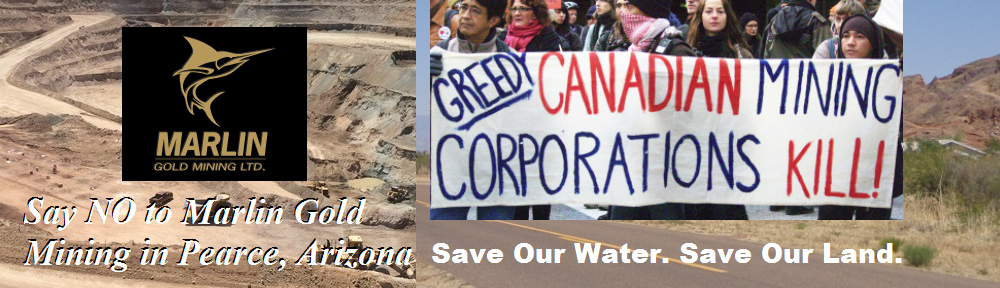
Technical Reports of Commonwealth Silver, Canada

Technical Reports of Commonwealth Silver, Canada

Updated National Instrument 43-101 Technical Report on Resources
Commonwealth Silver and Gold Project, Cochise County, Arizona, USA
Report Date:  September 5, 2013,  Effective Date:  June 10, 2013
Prepared by:  Hard Rock Consulting, LLC

Initial National Instrument 43-101 Technical Report on Resources
Commonwealth Silver and Gold Project, Cochise County, Arizona, USA
Report Date:  March 15, 2012, amended April 11, 2013, Effective Date:  October 11, 2011
Prepared by:  SRK Consulting (U.S.), Inc.

Source: http://commonwealthsilver.ca/projects/technical_reports/

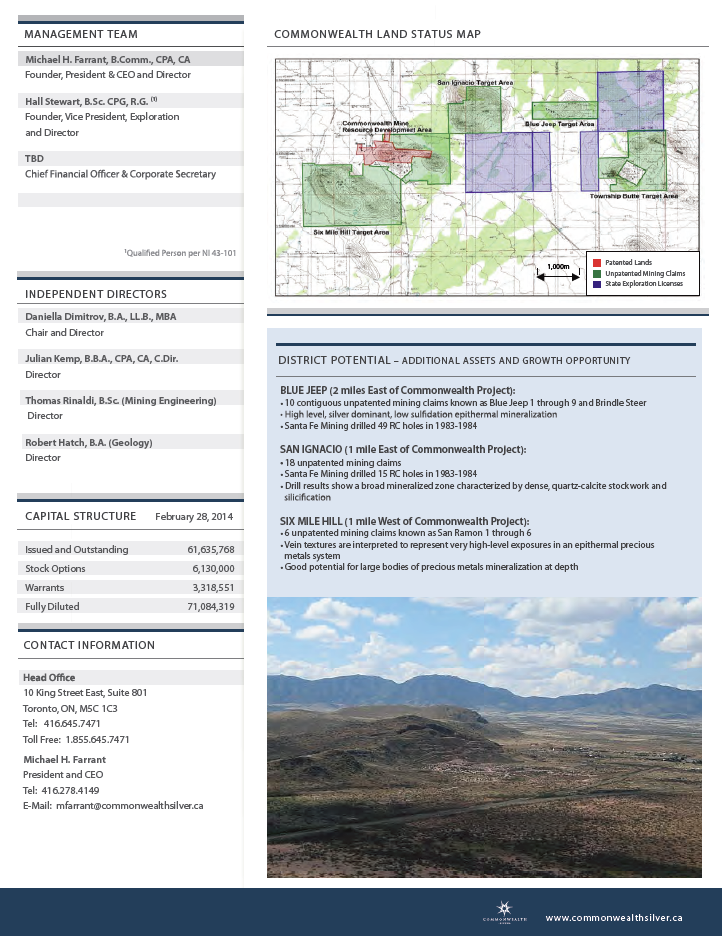
Investor Fact Sheet of Commonwealth Silver, Canada

Investor Fact Sheet of Commonwealth Silver, Canada

1

New Picture (1)

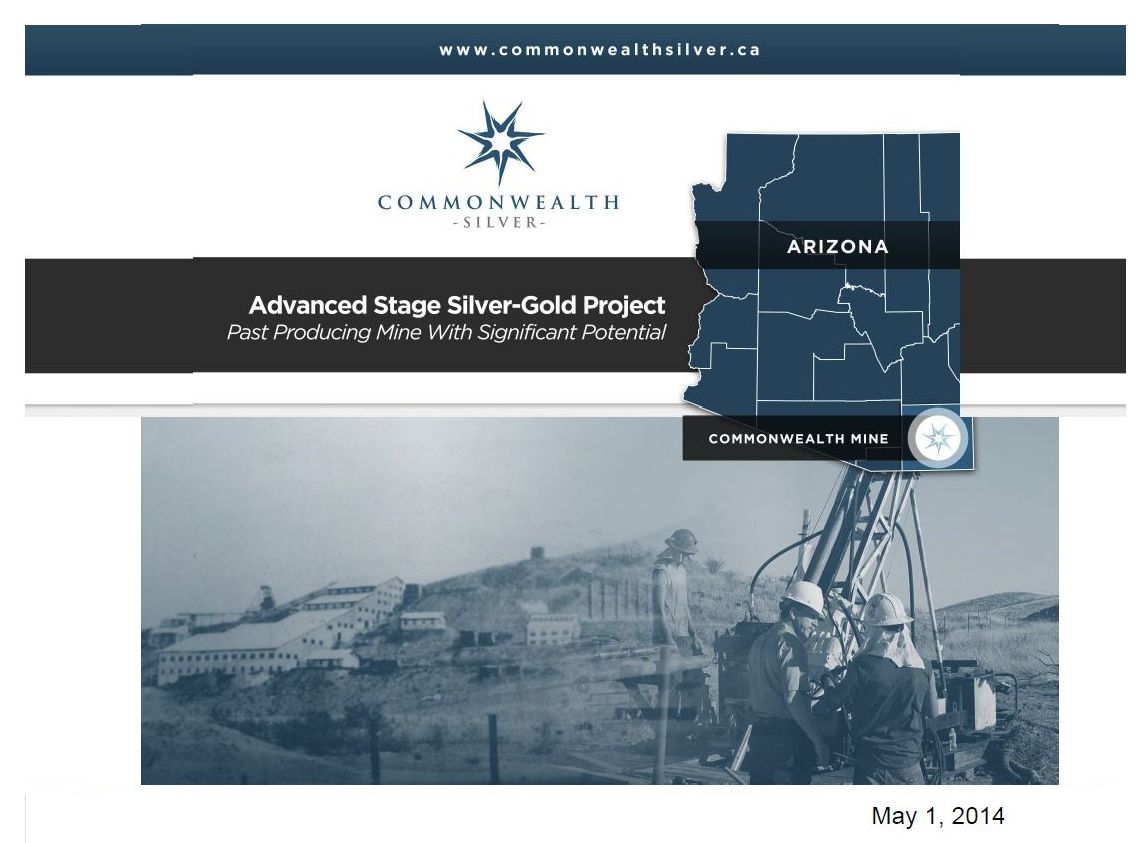
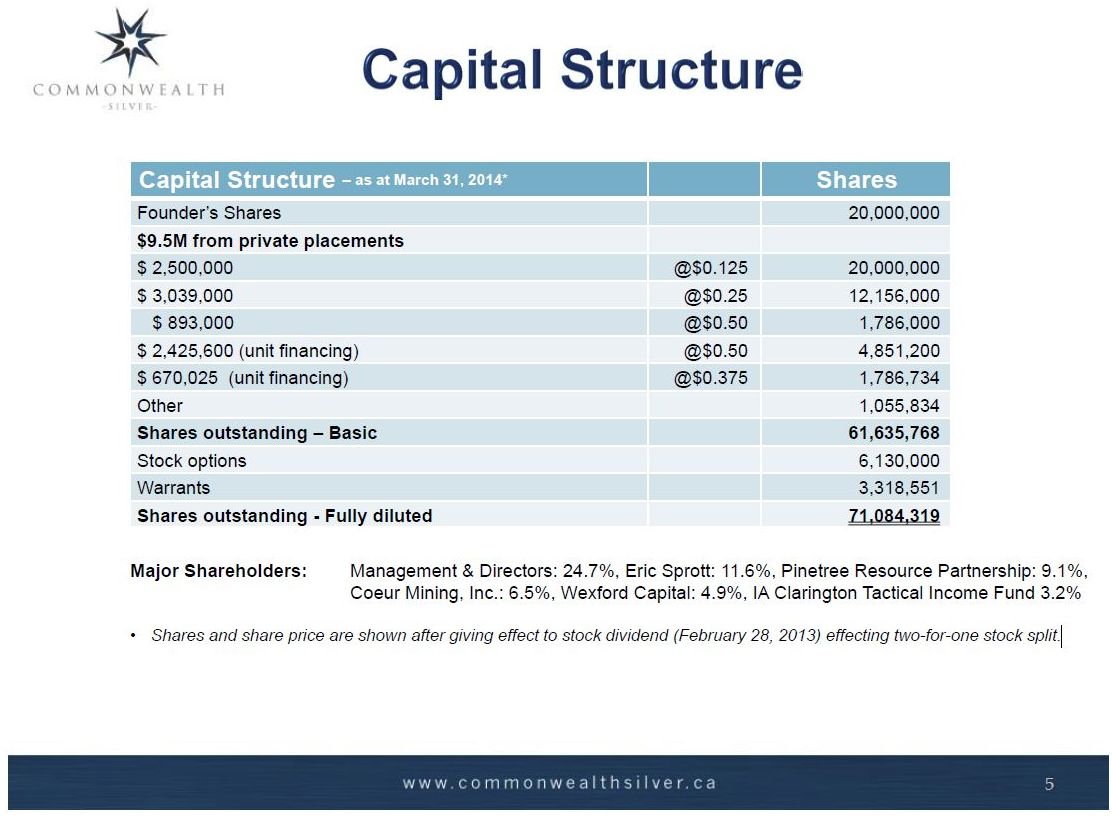
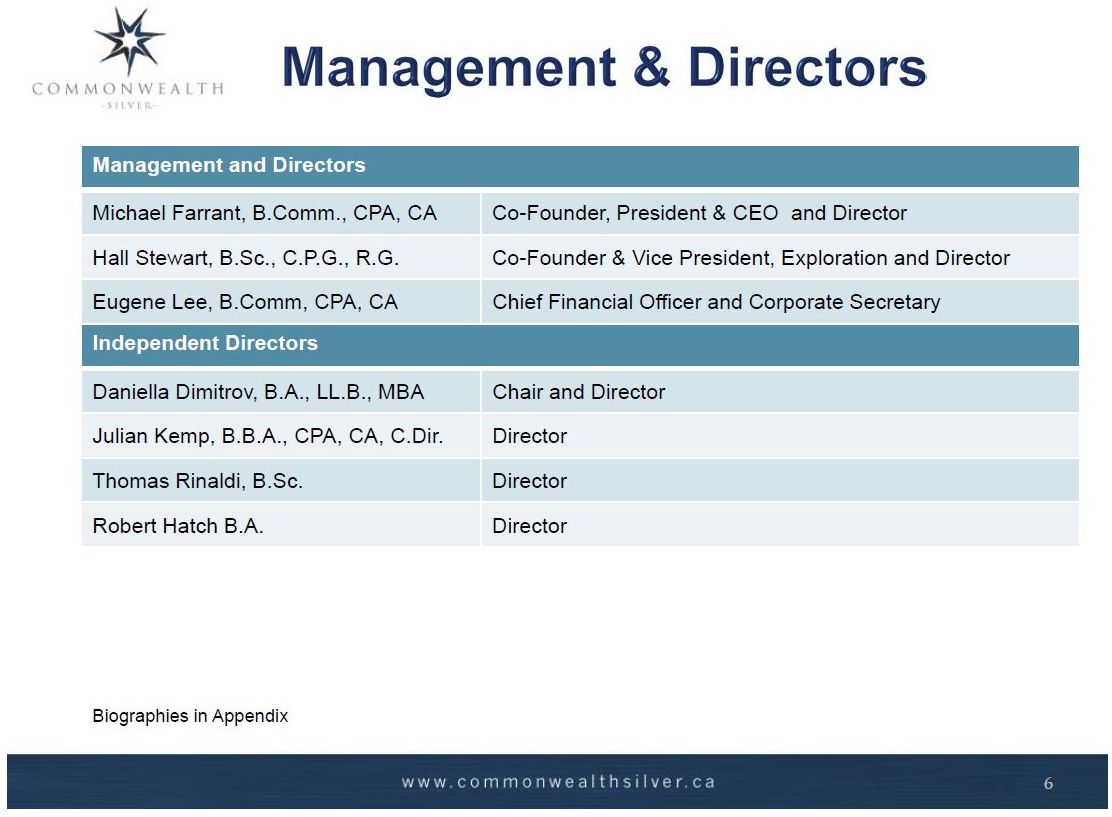
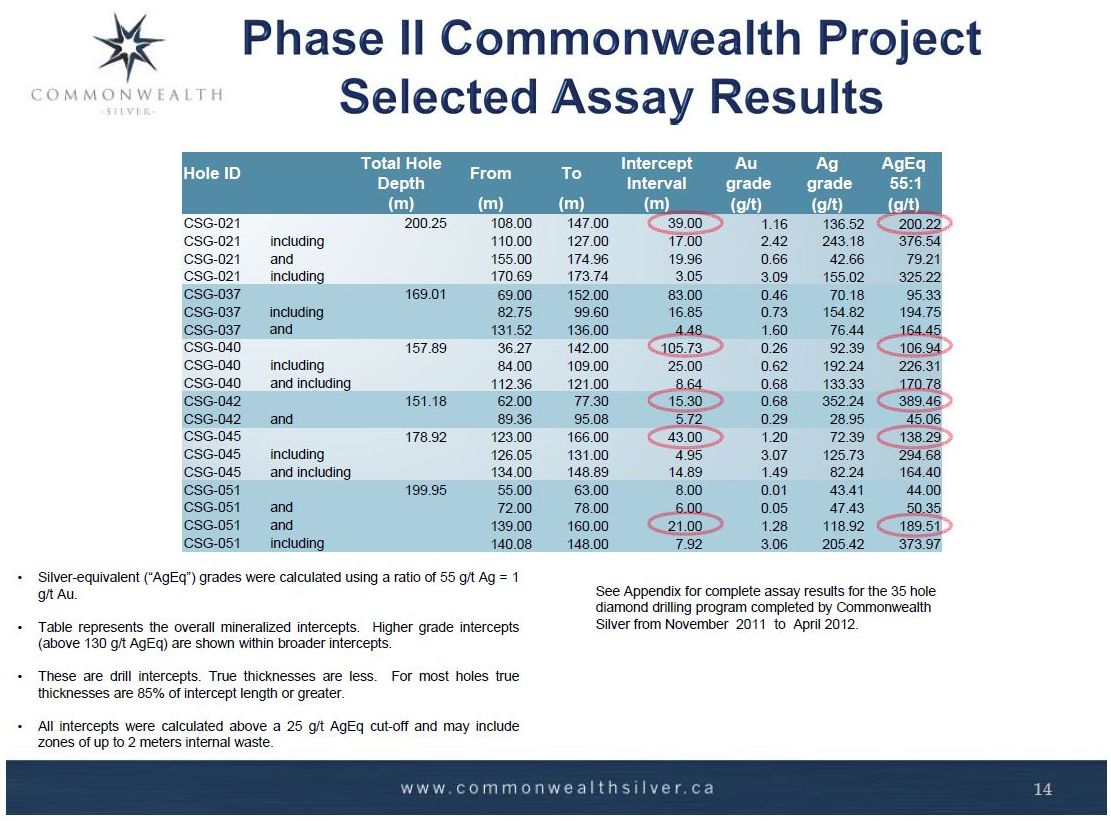
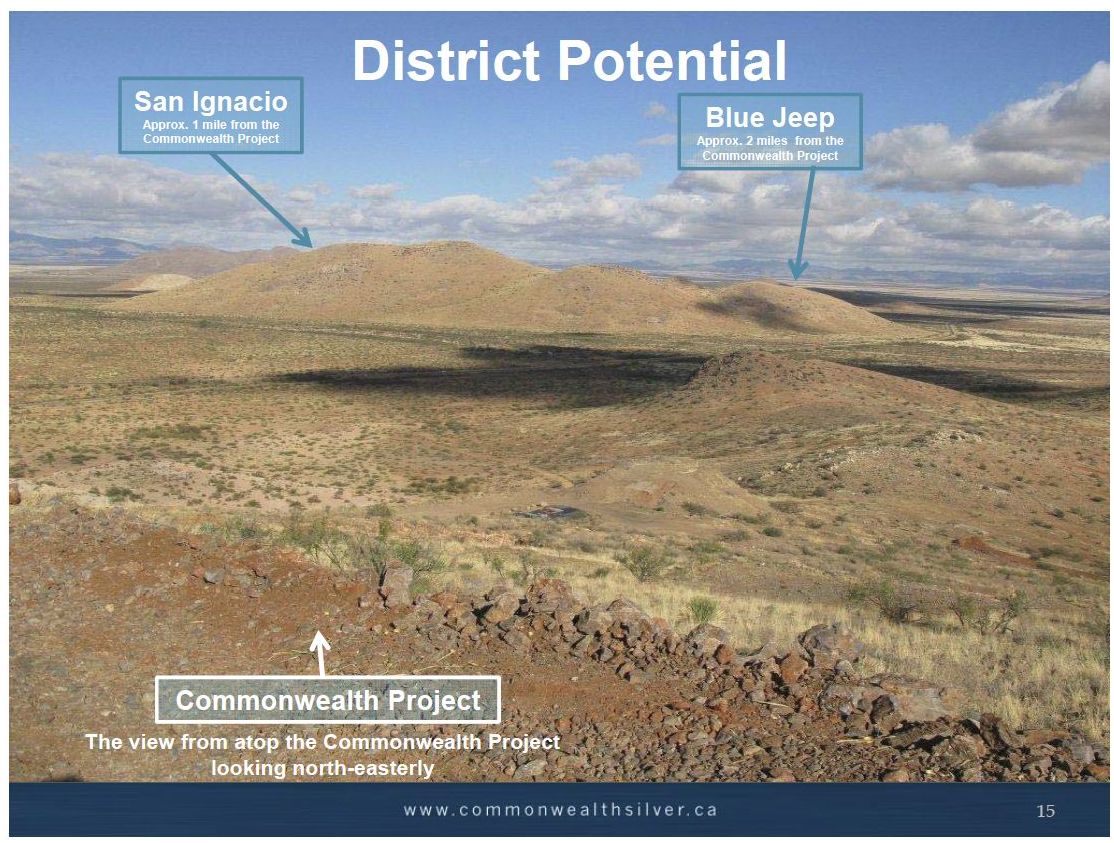
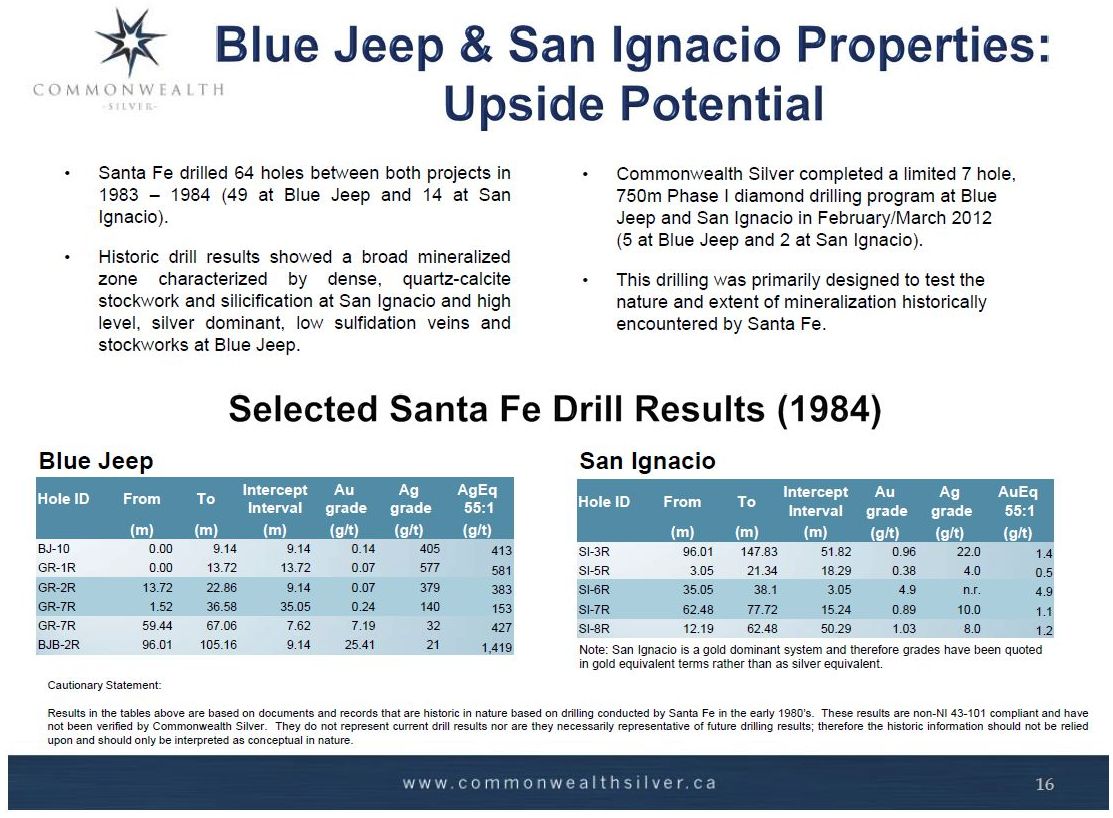
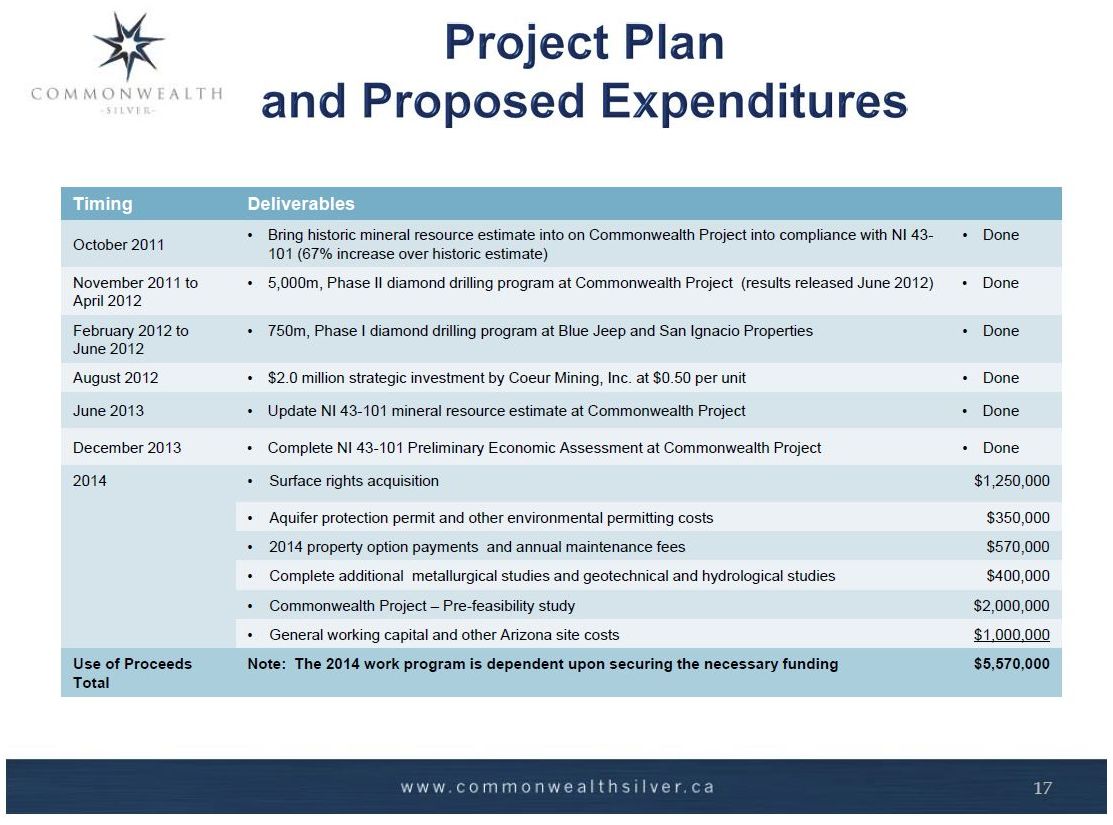
Corporate Presentation of Commonwealth Silver, Canada – May 1, 2014

Corporate Presentation of Commonwealth Silver, Canada – May 1, 2014

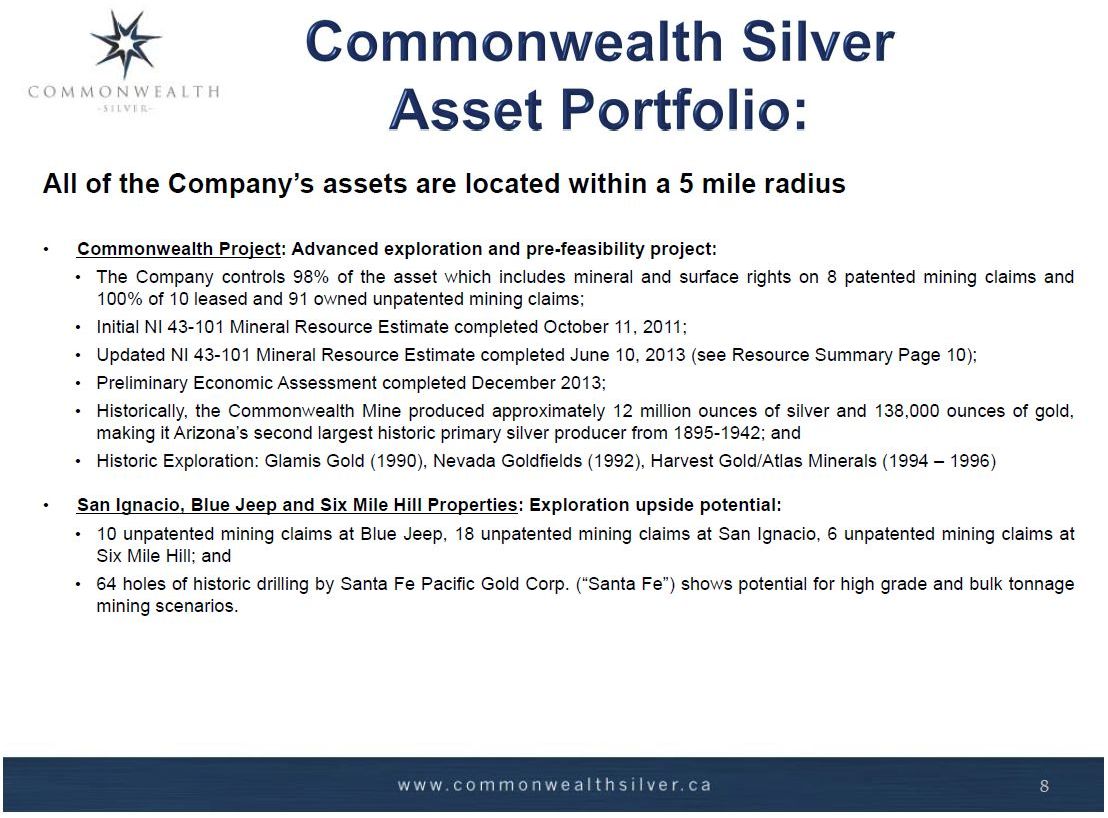
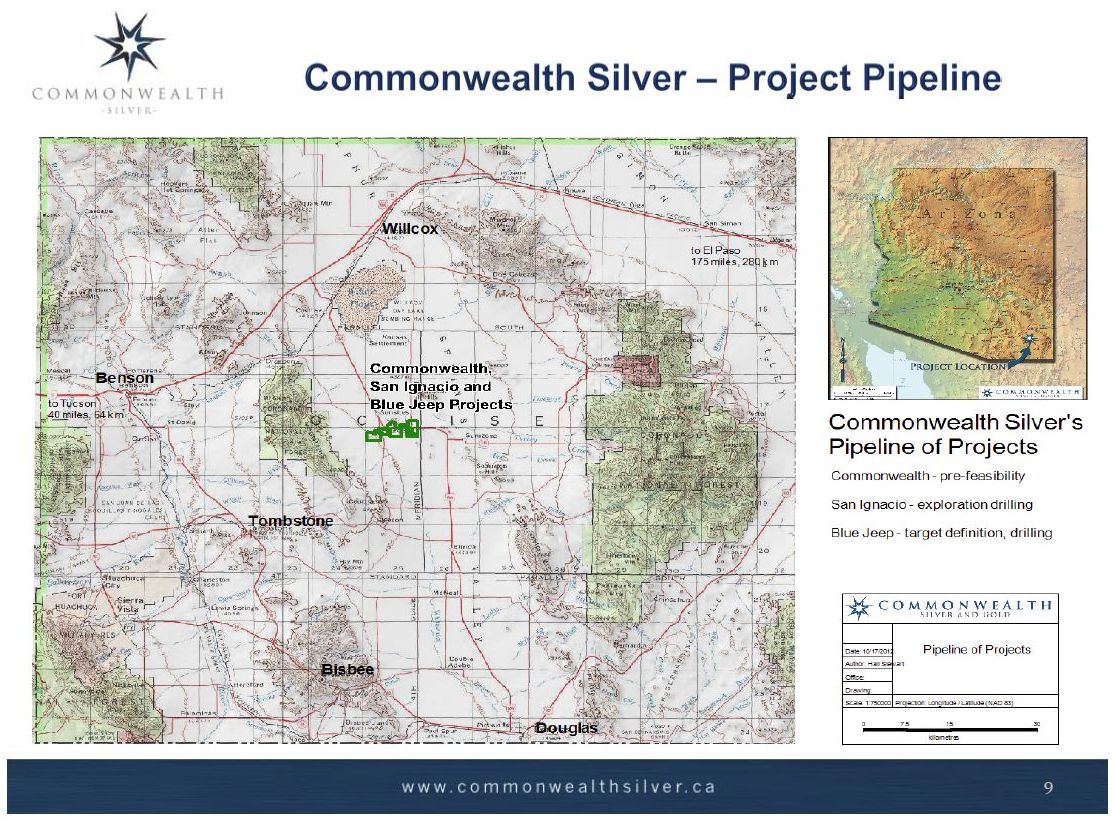
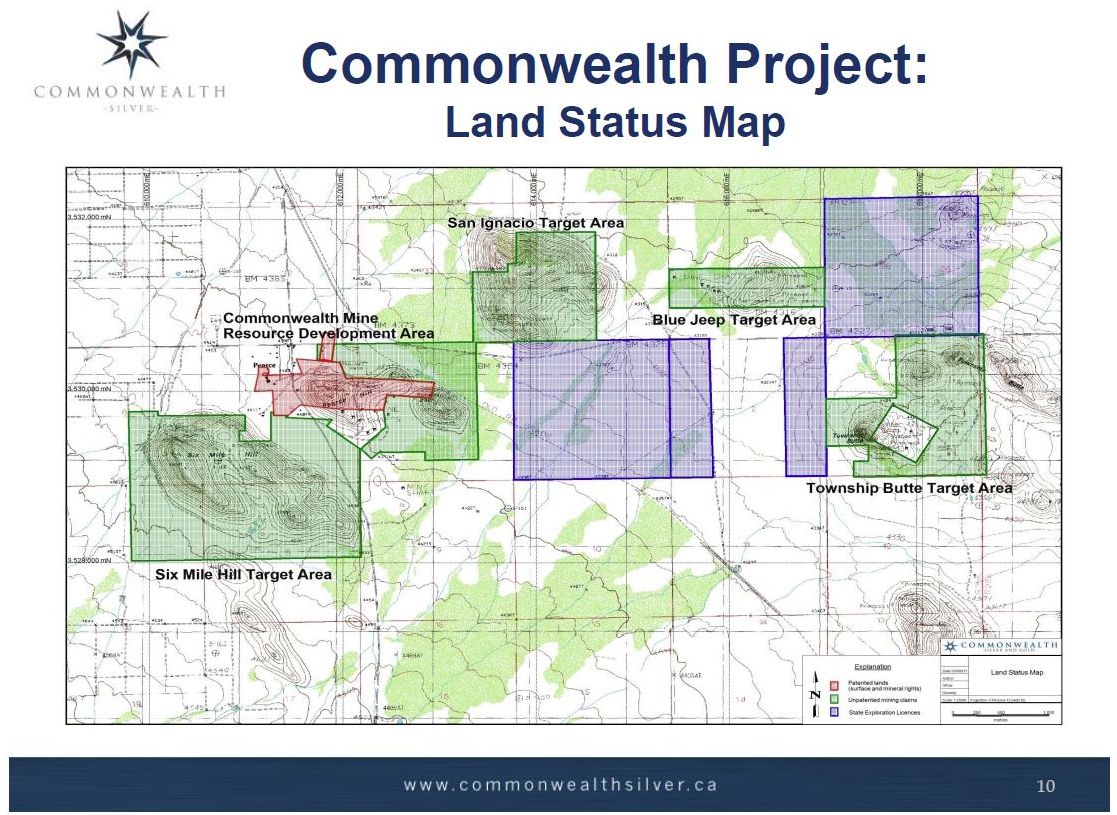
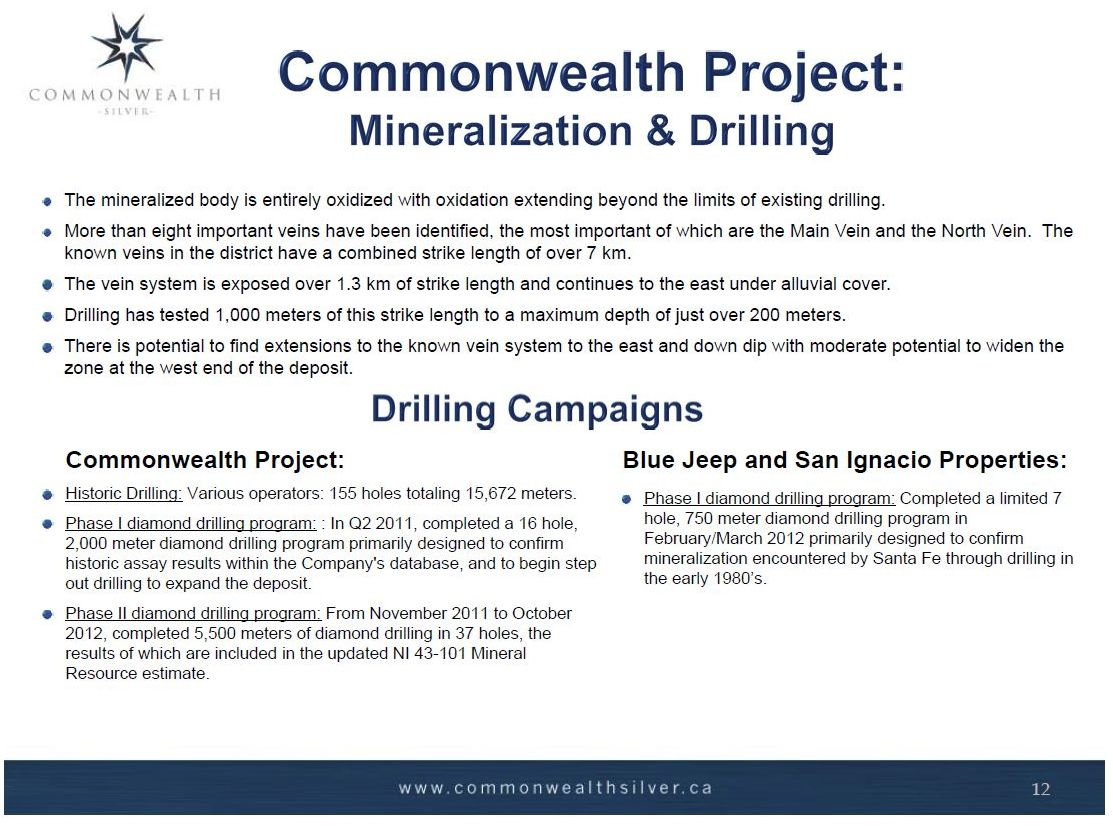
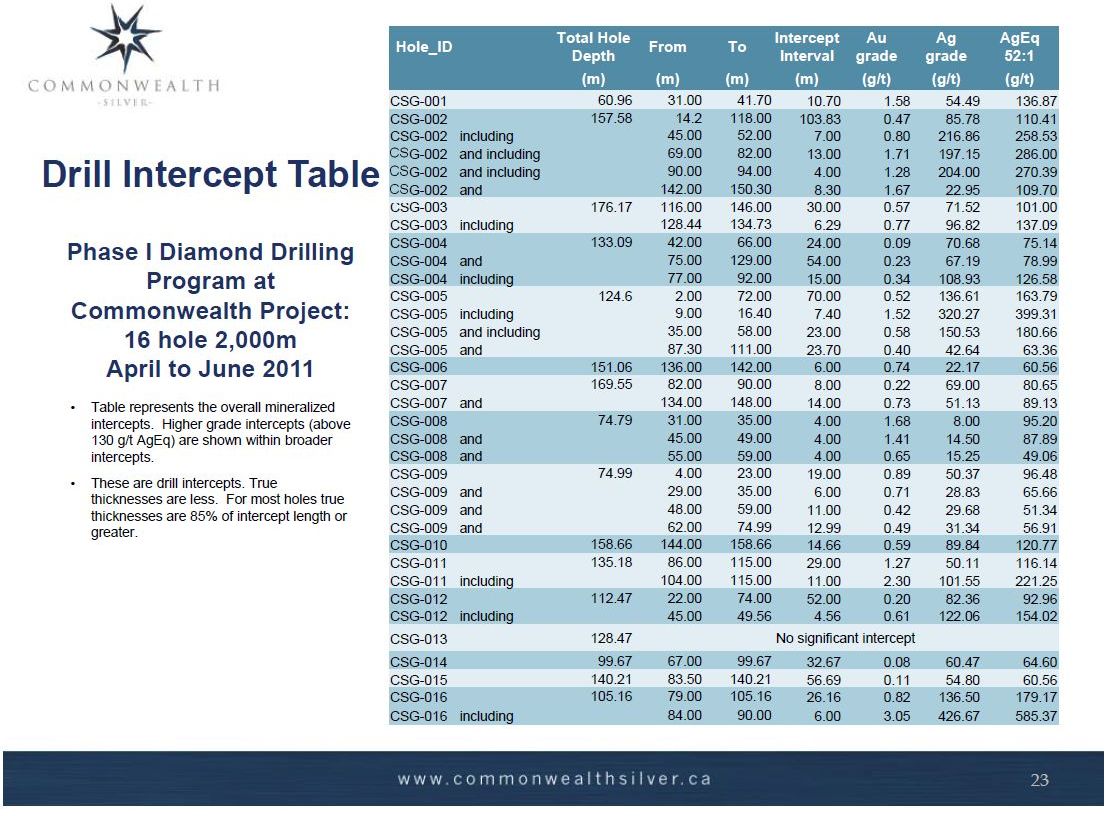
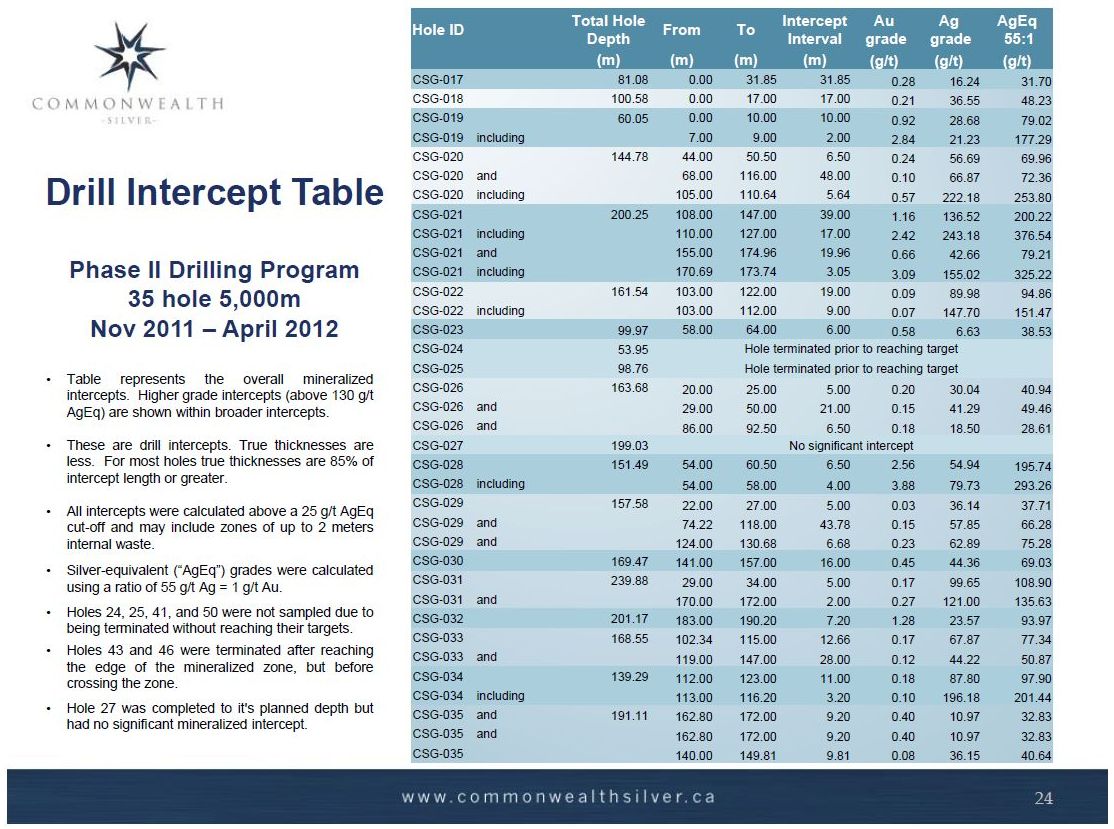
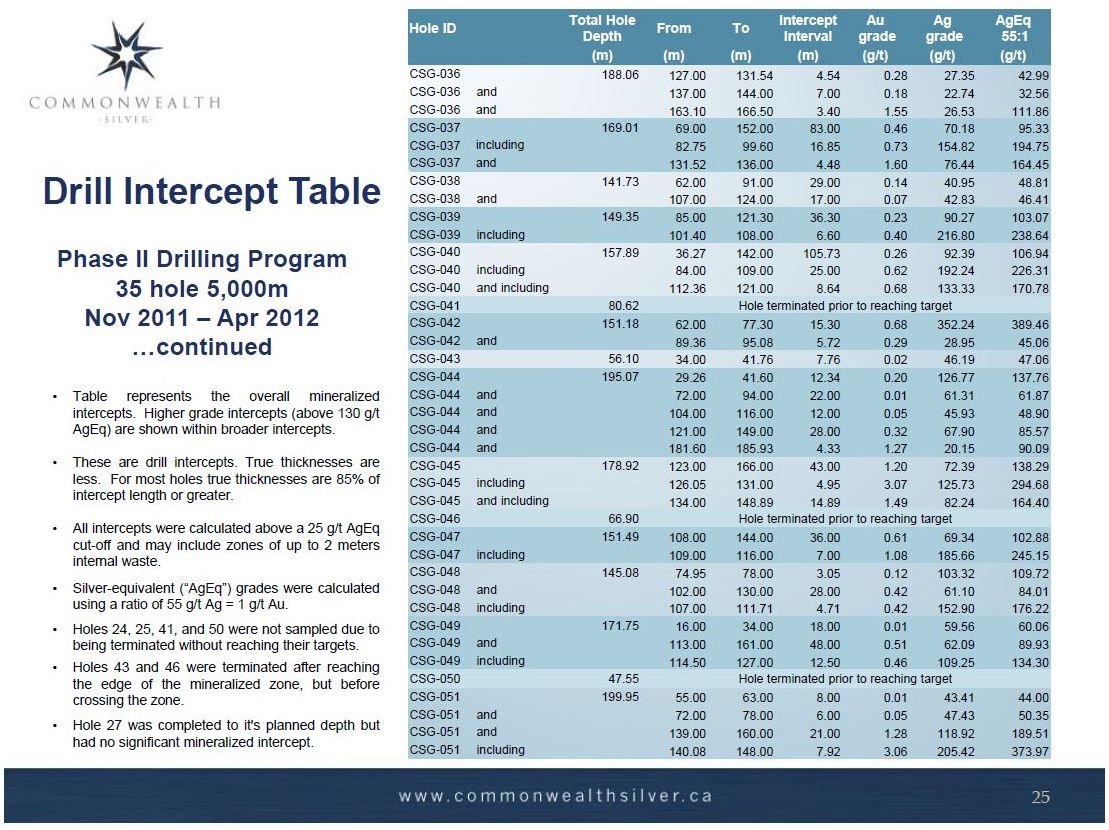
1 New Picture (1) New Picture (2) New Picture (3) New Picture (4) New Picture (5) New Picture (6) New Picture (7) New Picture (8) New Picture (9) New Picture (10) New Picture (11) New Picture (12) New Picture (13) New Picture (14) New Picture (15) New Picture (16) New Picture (17) New Picture (18) New Picture (19) New Picture (20) New Picture (21) New Picture (22) New Picture (23) New Picture (24)

Source: http://commonwealthsilver.ca/investors/presentation/

Environmental Risks of Mining – The Future of Strategic Natural Resources by MIT

Environmental Risks of Mining – How they arise and how their effects can be mitigated.

Unregulated mining has the potential to release harmful substances into the soil, air, and water. Mission 2016 proposes that governments enforce regulations on companies and use cutting-edge technology to reduce the damage from mining-related sources. As more mines open in countries with varying levels of environmental protection, it is increasingly vital that safeguards established by the Strategic Minerals Association (SMA) are in place before operations proceed... Read more


Overview of Global Problems
– The strategic element crisis; depleting supplies, increasing demand, fluctuating prices, human rights violations, and pollution.

As global population and technology usage increases, it is becoming apparent that the world is unprepared to deal with the situation of depleting supply of critical elements. It is clear that Earth’s resources cannot sustain our consumption rates without major alterations to the consumption and usage of these elements Read more


Environmental Damage

The list of environmental concerns that can be connected with rare earth elements is not a
brief one. Throughout the cycle of mining processes that rare earth elements go through, there is potential for negative effects on the environment. Extracting rare earth elements begins with mining. This is followed by the refining process, and then disposal. All of the stages of mining, refining, and disposal come with unique issues… Read more


Human Rights & Developing Countries

Minable ores of critical resources are located around the planet, sometimes concentrated in just a handful of economically viable deposits. Platinum-group elements, uranium, tantalum, niobium, and phosphorus are distributed unevenly in a few, scattered pockets around the globe. As minerals do not adhere to political borders, the most desirable mining zones are often located in countries lacking the economic or technological means to take full advantage of them. Too frequently, poor governmental management of the resources allows control of their mining and sale to fall into the hands of warlords, militias, and anyone else willing to resort to violence and terror Read more


Lack of Regulation

Currently, the only existing regulations on potential environmental and occupational safety issues in the mining industry are those posed by national governments. However, these laws differ from country to country and many companies find ways to circumvent these legal bindings through lobbying, and in some countries, bribing. The lack of international mining safety and environmental standards necessitates a globally accepted protocol that will enforce regulations preventing the contamination of water, air, and soil, and the advent of fatal mining accidents Read more


Limited Access

A key challenge for strategic elements is the concentration of many of the world’s largest deposits and reserve bases in a small number of countries. As the global economy grows more dependent on individual nations for mineral supplies, political, environmental, or economic problems within these producing nations could quickly and negatively influence world strategic mineral prices. For example, price hikes, export regulations, and trade embargos can limit the availability and affordability of strategic minerals to resource-dependent consumers… Read more


Public Awareness

Most people do not know about where things they use every day come from. While this is partially due to lack of concern, in many cases the information is obscured by companies concerned about competitors and concerned with hiding unethical practices. This means that consumers who would like to be environmentally and socially conscious do not ever have the opportunity, and companies that engage in deplorable practices are allowed to continue without financial pressure... Read more


Cost of Inaction
The Price of Prolonging the Status Quo Will Cost the World.

The entire world is in danger of a resource crisis. As human population grows and the demand for natural resources increases there will be a shortage in many commodities including strategic elements. Without strategic elements such as platinum group elements, rare earth metals and phosphorus, maintaining global populations and the global economy will become exceedingly difficult Read more

Source: http://web.mit.edu/12.000/www/m2016/finalwebsite/problems/mining.html
Corporate Governance & Board of Directors of Commonwealth Silver, Canada

Information About Commonwealth Silver, Canada

Corporate Governance


As a private company, Commonwealth Silver strives to set itself apart by undertaking a commitment to corporate governance on par with companies publicly listed on the Toronto Stock Exchange. We aim to earn and retain the trust of potential and existing shareholders alike. Our governance practices reflect the structure and processes we believe should be inherent in all companies with a responsibility to shareholders, whether public or private. As governance standards change, and our Company grows, these practices will be assessed and modified as required.

Board of Directors


Our Board consists of six directors. Four of these directors including the Chair, comprising a majority of the Board, are independent of management and free from any interest or business that could materially interfere with their ability to act in the Company’s best interests. The Board is ultimately responsible for overseeing the management of the business and affairs of the Company and, in doing so, is required to act in the best interests of the Company. The Board discharges its responsibilities either directly or through three committees, all of which are comprised entirely of independent directors:

Audit Committee
Nominating and Corporate Governance
Committee
Compensation Committee
  • Julian Kemp – Chair
  • Daniella Dimitrov
  • Thomas Rinaldi
  • Daniella Dimitrov – Chair
  • Julian Kemp
  • Thomas Rinaldi
  • Daniella Dimitrov – Chair
  • Julian Kemp
  • Thomas Rinaldi

Source: http://commonwealthsilver.ca/corporate/governance/

Message to Shareholders – Commonwealth Silver, Canada – Investor Information

Message to Shareholders – As per Commonwealth Silver, Canada

Oct 19, 2011
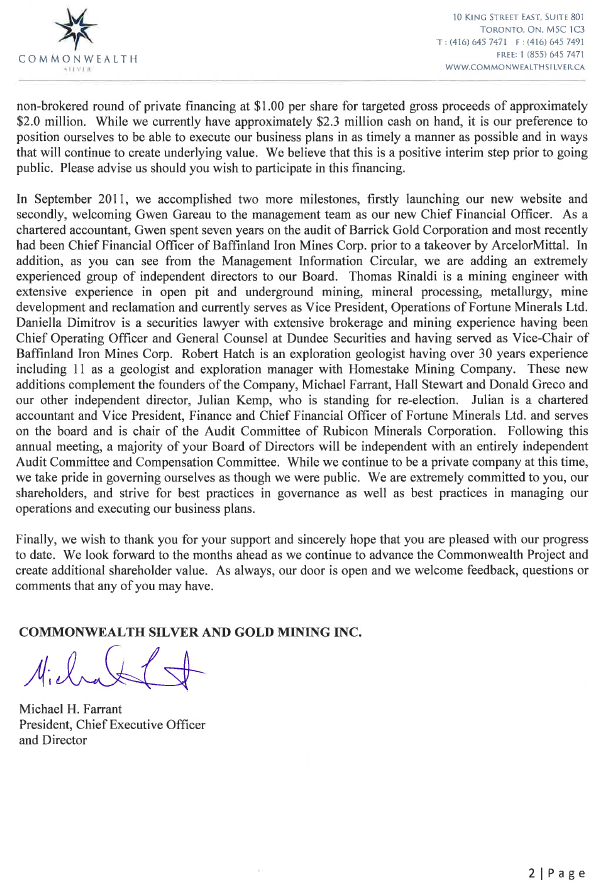
President’s Message to Shareholders
page1

page2

page3

Mar 21, 2011
Shareholder Update

1

2

3

4

Source: http://commonwealthsilver.ca/corporate/message/

Investor Information Board of Directors – Commonwealth Silver, Canada

Board of Directors – As per Commonwealth Silver, Canada

Daniella Dimitrov, B.A., LL.B., MBA – Chair

Ms. Dimitrov has over 18 years of broad capital markets, commercial and operational experience. She currently serves as CFO of Orvana Minerals Corp., a position she has held from June 2012 to present. Ms. Dimitrov has previously held various consulting roles in the mining industry since 2009, including director and Vice Chair of Baffinland Iron Mines. Ms. Dimitrov’s former positions include Senior Vice President, Strategic Initiatives of Raymond James Ltd. from 2006 to 2008 and Chief Operating Officer of Dundee Securities from 2005 to 2006. She is currently a director of Aldridge Minerals Inc. Ms. Dimitrov has a Bachelor of Laws from the University of Windsor and recently completed an Executive MBA at Kellogg School of Management and Schulich School of Business.

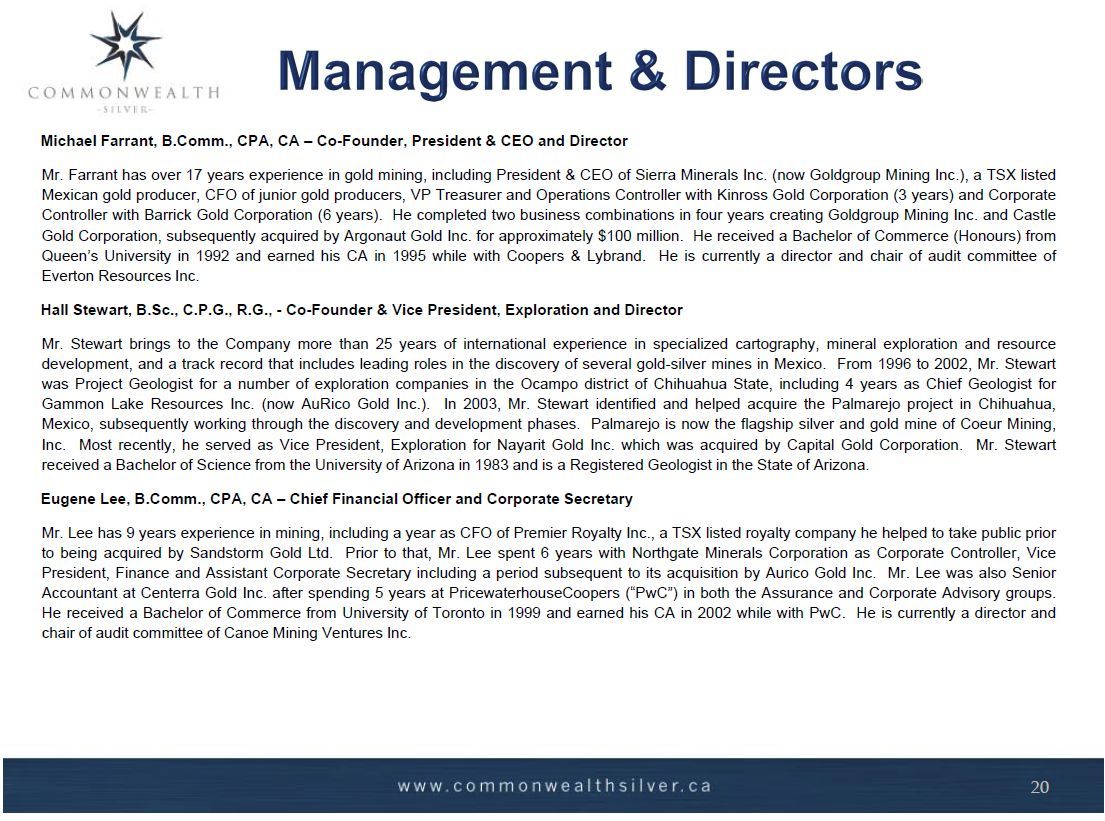
Michael Farrant, B.Comm., CPA, CA

Mr. Farrant has over 16 years experience in gold mining, including President and CEO of Sierra Minerals Inc. (now Goldgroup Mining Inc.), a TSX-listed Mexican gold producer, CFO of junior gold producers, Vice President and Treasurer and Operations Controller with Kinross Gold Corporation (3 years) and Corporate Controller with Barrick Gold Corporation (6 years). He completed two business combinations in four years creating Goldgroup Mining Inc. (TSX:GGA) and Castle Gold Corporation, subsequently acquired by Argonaut Gold Inc. (TSX:AR). He received a Bachelor of Commerce (Honours) from Queen’s University in 1992 and earned his CA in 1995 while with Coopers & Lybrand. He is currently a director and chair of the audit committee of Everton Resources Inc. (TSX-V: EVR).

Hall Stewart, B.Sc., C.P.G., R.G.

Mr. Stewart brings to the Company more than 25 years of international experience in specialized cartography, mineral exploration and resource development, and a track record that includes leading roles in the discovery of several gold-silver mines in Mexico. From 1996 to 2002, Mr. Stewart was Project Geologist for a number of exploration companies in the Ocampo district of Chihuahua State, including 4 years as Chief Geologist for Gammon Lake Resources Inc. (now AuRico Gold Inc.). In 2003, Mr. Stewart identified and helped acquire the Palmarejo project in Chihuahua, Mexico, subsequently working through the discovery and development phases. Palmarejo is now the flagship silver and gold mine of Coeur Mining, Inc. Most recently, he served as Vice President, Exploration for Nayarit Gold Inc. which was then acquired by Capital Gold Corporation. Mr. Stewart received a Bachelor of Science from the University of Arizona in 1983 and is a Registered Geologist in the State of Arizona.

Julian Kemp, B.B.A., CPA, CA, C. Dir.

Mr. Kemp has over 25 years experience in the mining industry, primarily serving in senior financial and administrative management roles. He also has over 10 years experience serving as  a corporate director with numerous public companies.  His experience includes North American and international operations with precious metals, base metals and coal projects.  Throughout his career, he has focused on financing, restructuring and transforming exploration and development companies into producers.  He most recently served as Vice President, Finance and Chief Financial Officer of Fortune Minerals Limited, a position he held from 2004 to January 2014.  Mr. Kemp is currently a director and Audit Committee Chairman of Rubicon Minerals Corporation (TSX:RMX; NYSE:RBY) and a director of Marathon Gold Corporation (TSX:MOZ). Mr. Kemp is a Chartered Accountant and holds a Bachelor of Business Administration degree from Wilfred Laurier University.

Thomas Rinaldi, B.Sc.

Mr. Rinaldi currently works in Zambia as the General Manager Technical & Projects for Konkola Copper Mines Plc, an integrated copper producer and subsidiary of FTSE-listed Vedanta Resources Plc. He is a mining engineer with 28 years of management and engineering experience in precious and base metals and industrial minerals. From 2006 to 2008 he was Vice President, Operations at Candente Resource Corporation (TSX: DNT) and then served as Vice President, Operations at Fortune Minerals Limited from 2008 to 2012. His experience covers open pit and underground mining, mineral processing including significant heap leaching experience with gold and copper, metallurgy, preliminary economic assessment work, mine design and development and reclamation. Mr. Rinaldi received a B.Sc. in Mining Engineering from the University of Arizona in 1983.

Robert Hatch, B.A.

Mr. Hatch is a consulting geologist with over 30 years of experience with junior mining and exploration companies in the United States and internationally. From 2003 to 2005 he served as Vice President, Exploration of Romarco Minerals Inc. (TSX: R) and is currently President and Owner of two privately-held Nevada mining companies. His experience also includes 11 years as an exploration geologist and manager with Homestake Mining Company. Mr. Hatch received a B.A. in Geology from California State University, Fullerton in 1976.

Source: http://commonwealthsilver.ca/corporate/directors/

Commonwealth Mine, Pearce, Arizona – Photos

New Picture (2)  New Picture (3)

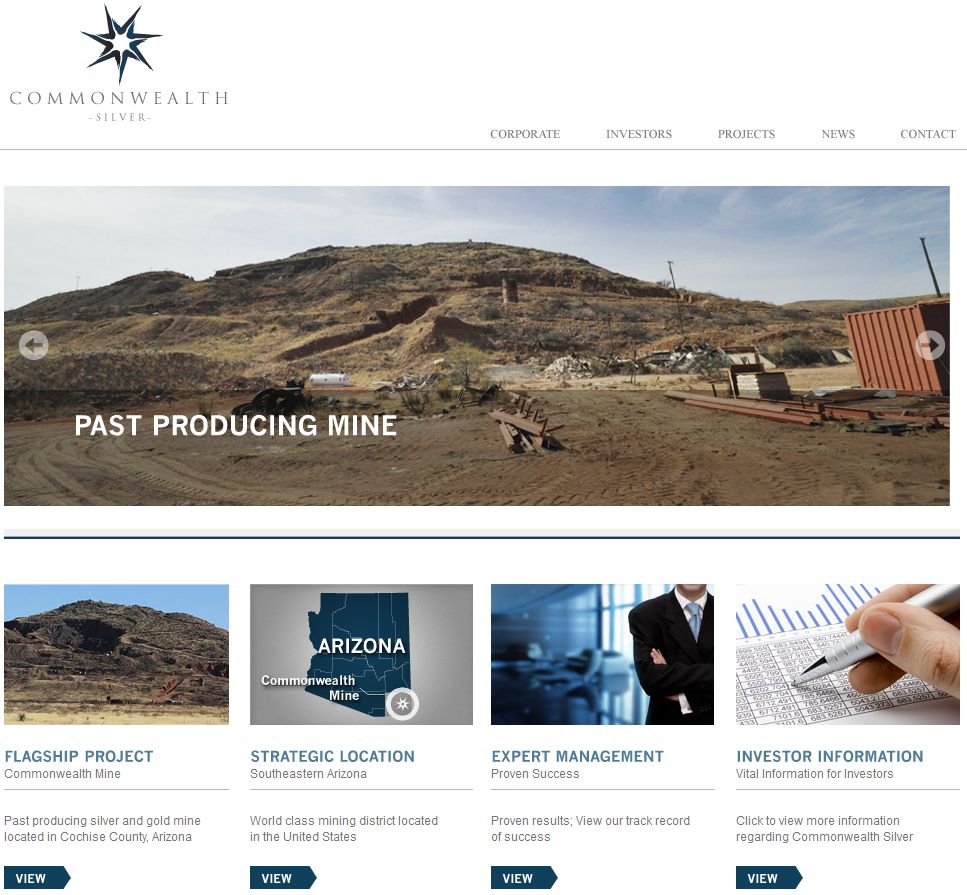
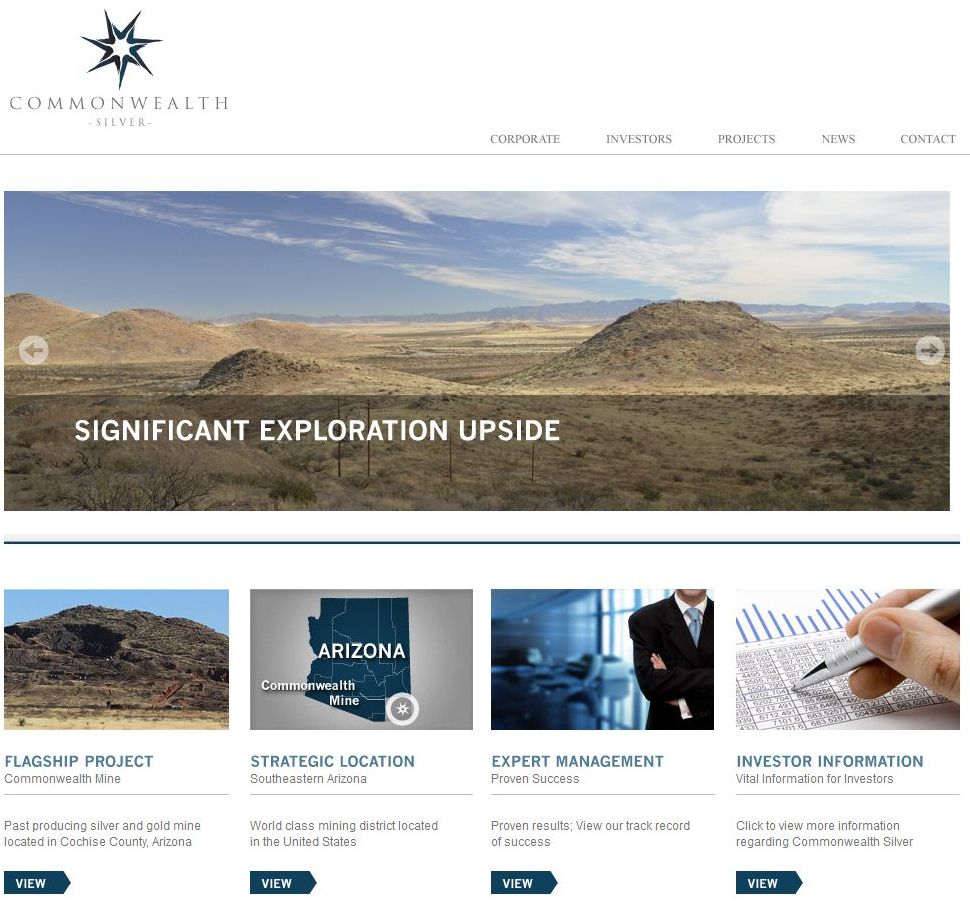
Screen shots of http://commonwealthsilver.ca/ for historical record.